REPAIRING AND NOT THROWING AWAY

Richtige Fernseher haben Röhren!

Richtige Fernseher haben Röhren!

In Brief: On this site you will find pictures and technical information about Service Modes, Circuit Diagrams, Firmware Update procedure, Disassemble procedure, Universal remote control set-up codes, Troubleshooting and more....

If you go into the profession, you will obtain or have access to a variety of tech tips databases HERE IT IS Master Electronics Repair !.

These are an excellent investment where the saying: 'time-is-money' rules. However, to learn, you need to develop a general troubleshooting approach - a logical, methodical, method of narrowing down the problem. A tech tip database might suggest: 'Replace C536' for a particular symptom. This is good advice for a specific problem on one model. However, what you really want to understand is why C536 was the cause and how to pinpoint the culprit in general even if you don't have a service manual or schematic and your tech tip database doesn't have an entry for your sick TV or VCR.

While schematics are nice, you won't always have them or be able to justify the purchase for a one-of repair. Therefore, in many cases, some reverse engineering will be necessary. The time will be well spent since even if you don't see another instance of the same model in your entire lifetime, you will have learned something in the process that can be applied to other equipment problems.
As always, when you get stuck, checking out a tech-tips database may quickly identify your problem and solution.In that case, you can greatly simplify your troubleshooting or at least confirm a diagnosis before ordering parts.

Happy repairing!
Today, the West is headed for the abyss. For the ultimate fate of our disposable society is for that society itself to be disposed of. And this will happen sooner, rather than later.

How to use the site:

- If you landed here via any Search Engine, you will get what you searched for and you can search more using the search this blog feature provided by Google. You can visit more posts scrolling the left blog archive of all posts of the month/year,
or you can click on the main photo-page to start from the main page. Doing so it starts from the most recent post to the older post simple clicking on the Older Post button on the bottom of each page after reading , post after post.

You can even visit all posts, time to time, when reaching the bottom end of each page and click on the Older Post button.

- If you arrived here at the main page via bookmark you can visit all the site scrolling the left blog archive of all posts of the month/year pointing were you want , or more simple You can even visit all blog posts, from newer to older, clicking at the end of each bottom page on the Older Post button.
So you can see all the blog/site content surfing all pages in it.

- The search this blog feature provided by Google is a real search engine. If you're pointing particular things it will search IT for you; or you can place a brand name in the search query at your choice and visit all results page by page. It's useful since the content of the site is very large.

Note that if you don't find what you searched for, try it after a period of time; the site is a never ending job !

..............The bitterness of poor quality is remembered long after the sweetness of todays funny gadgets low price has faded from memory........ . . . . . .....
Don't forget the past, the end of the world is upon us! Pretty soon it will all turn to dust!

©2010, 2011, 2012, 2013, 2014 Frank Sharp - You do not have permission to copy photos and words from this blog, and any content may be never used it for auctions or commercial purposes, however feel free to post anything you see here with a courtesy link back, btw a link to the original post here , is mandatory.
All posts are presented here for informative, historical and educative purposes as applicable within fair use. NOTHING HERE IS FOR SALE !

Showing posts with label INSTRUMENT. Show all posts

Monday, 8 April 2019

PHILIPS PM2502 ANALOGUE MULTIMETER AND HUNG CHANG 303TR DIGITAL MULTIMETER CIRCUIT DIAGRAM (SCHEMATIC)

Philips PM2502 Analogue Multimeter and Hung Chang 303TR Digital Multimeter circuit diagram (Schematic)

Philips PM2502 Analogue Multimeter Circuit diagram and specifications
HUNG CHANG 303TR Digital multimenter circuit diagram
 Ex-Or gate truth table

UNI-T DIGITAL MULTIMETER SCHEMATIC

UNI-T digital multimeter schematic


Digital Multi-tester circuit diagram. Used ICs: AME7106ACKW, CD14066, 4093, 4011
Schematic
Click on the schematic to zoom in

Saturday, 6 April 2019

METRAWATT UNIGOR 4S ANALOG MULTIMETER AND CAST ELENCO M1250K ANALOG MULTIMETER – SCHEMATIC

Metrawatt Unigor 4S Analog Multimeter and Cast Elenco M1250K Analog Multimeter – Schematic

M1250K Elenco Analogue Multimeter
Cast M1250K Analog Multimeter circuit diagram
Metrawatt Unigor 4S Analog Multimeter circuit diagram

Saturday, 30 March 2019

FLUKE 192B _196B-C _199B-C SCOPE-METER SCHEMATIC

FLUKE 192B _196B-C _199B-C Scope-Meter SCHEMATIC

ATTENTIONNever attempt to open this instrument, unless you’re familiar with repairing measuring instruments.  This is a very delicate and accurate measuring instrument and somewhat costly too. 
BATTERY
Battery operating time is does not meet the specification (4 hours)
1. Turn the ScopeMeter on (battery power only)
2. Check the voltage across R4101 (near the battery connector) for about 140 mV. This corresponds to a current of about 0.95 A. If the current is much higher the cause of the problem is not the battery.  
Battery is discharged when ScopeMeter is not used for some time (2 or 3 weeks).
1. Turn the ScopeMeter on (battery power only)
2. Check the voltage across R4101 (near the battery connector) for about 0.15 mV.  This corresponds to a current of about 1 mA. Turn the ScopeMeter off and on, and check the voltage again for 0.15 mV. Do this about 10 times.  If one or more times a current of about 1.2 mV is measured (8 mA), the cause is a defective IC D3550. This IC takes care of a correct power state of D3500.  As the 8 mA discharge current can have damaged the battery, you must check the battery capacity as described below.
3. If the current is much higher then 8 mA the cause of the problem is not or is not only D3550 
To check if the battery has a correct capacity
1. Do a battery refresh
2. Disconnect the BC190 Battery Charger/Power Adapter
3. Start a TrendPlot: RECORDER
4. When the battery is discharged the ScopeMeter will shut down. Now connect the BC190, turn the power on and check the length of the TrendPlot trace. For a new battery pack this should be about 4 hours. Depending on the number of applied charge cycles the battery capacity will decrease. If the TrendPlot trace has a length of 3 hours or less you may consider to replace the battery pack.
Loading Software
To load a new software version in the test tool contact an authorized Fluke Service center.
ELPLODED VIEW
FLY-BACK CONVERTER
1. Check the fly back converter output voltages +5V2, +3V3GAR (+3.3 V), +3V45, +2V6, -1V8, -5V2 and +30V.  Check FLTPOWIN1and FLTPOWIN2 (6.5Vrms, ≈ 70 kHz) on for example T1102 pin 3 and pin 5.
a.If one or more voltages are correct, then check the rectifier diodes, coils, and capacitors of the incorrect voltage (s)
b. If none of the voltages is correct, then the fly back converter does not run correctly, continue at step 2.
2. Check VBATT for >7 V.
3. Check N4000:49 (FLYGATE) for a square wave voltage of at least some volts (for a correct Fly Back Converter 50...100 kHz, ≅8 Vpp).  If no square wave is present on N4000:49 go to step 4.  If a square wave is present on pin 49 (maybe not the correct value), then check N4000:55 (FLYSENSP) for a saw tooth voltage of 50...100 kHz, 300 mVpp.
a. If no sawtooth voltage is present on N4000:55, no current or a DC current flows in FET V4001. The primary coil of T4001 or V4001 may be defective. Check also R4101 (current sense resistor); it can be fused due to a short in FET V4001.
b. An incorrect sawtooth on N4000:55 can be caused by:
* overloaded outputs (Frequency too low, <<50 kHz)
* underloaded outputs (Frequency too high, >>100 kHz)
* bad FET V4001 (Sawtooth voltage is not linear).
4. Check N4000:62 (PWRONOFF) for >+3V. If wrong, see Section 7.5.13 Power ON/OFF.
5. Check N4000:43 (COSC) for a triangle wave form, 50...100 kHz, +1.6 V to +3.2 V.  If wrong check C4123 and connections; check IREF, see step 6.
If all correct, then replace N4000.
6. Check N4000:74 (IREF) for 1.6 V. If wrong:
a. Check N4000:73 (REFPWM2) for +3V3. REFPWM2 is supplied by N4000, and derived from REFP. Check N4000:72 (REFP) for 1.22 V. If wrong, check V4114 and connected parts.
b. Check R4021, replace N4000.
7. Check N4000:51 (VOUTHI) for <2.5 V (nominal value 1.8 V). If wrong check R4014 and connections to N4000.
8. Check N4000:57 (IMAXFLY) for 570 mV. If wrong check R4020 and connections to N4000.
BACK-LIGHT
MAIN
CLICK ON THE PICTURES TO ZOOM IN

Monday, 18 March 2019

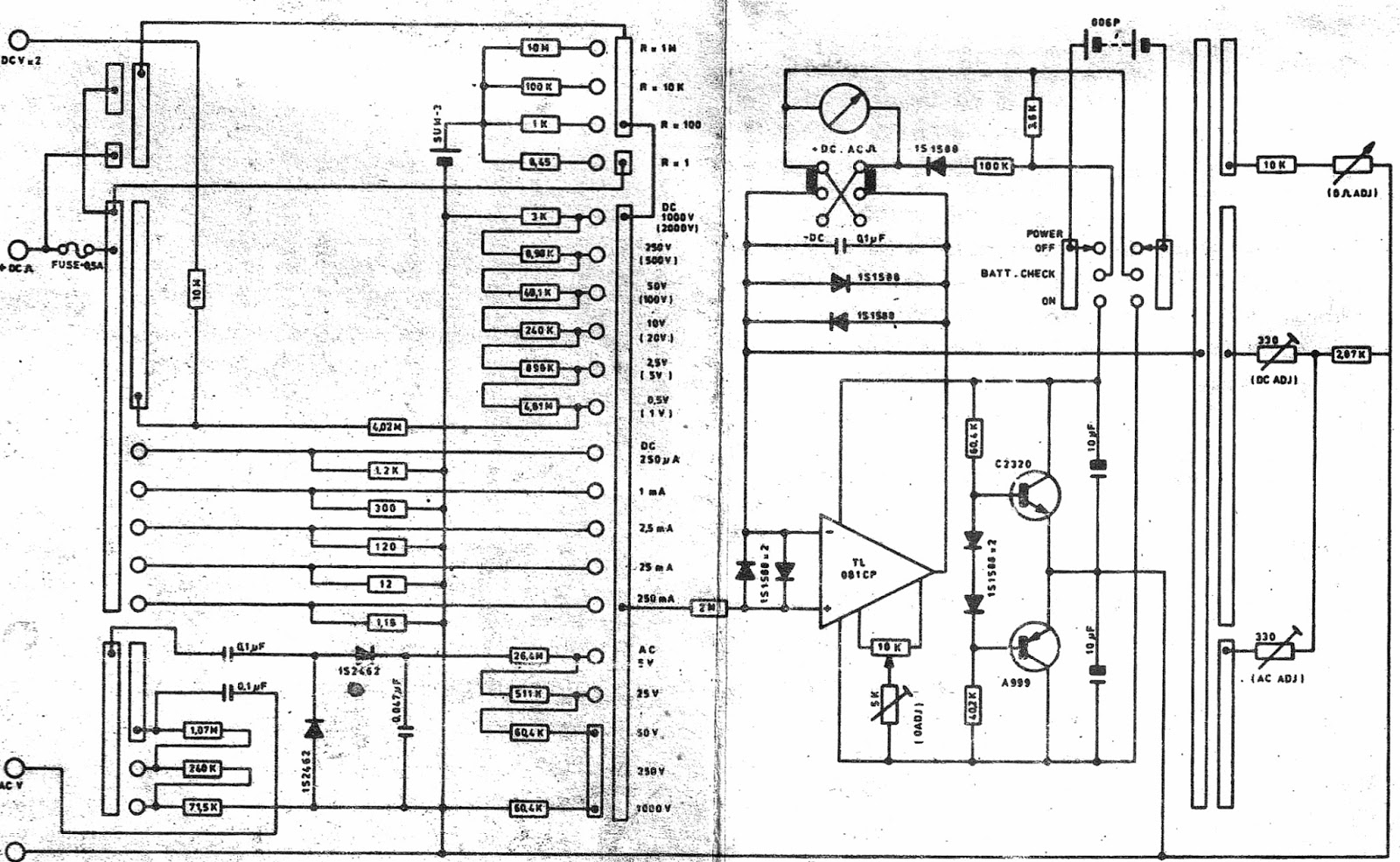
SANWA 320-X - ANALOGUE MULTIMETER - SCHEMATIC DIAGRAM

SANWA 320-X - ANALOGUE MULTIMETER - SCHEMATIC DIAGRAM


SCHEMATIC

Click on Schematic to Zoom In

HIOKI - 3080 ANALOGUE MULTIMETER - SCHEMATIC DIAGRAM [CIRCUIT DIAGRAM]

HIOKI - 3080 ANALOGUE MULTIMETER - SCHEMATIC DIAGRAM [Circuit Diagram]


SCHEMATIC
Click on schematic to Zoom In

Tuesday, 12 March 2019

RADIATION DETECTOR FOR GAMMA RAYS

RADIATION DETECTOR FOR GAMMA RAYS


RADIATION DETECTOR 

 GAMMA RAYS 

The first device that springs to mind when thinking about measuring radioactivity is the Geiger-Müller tube. However, these counter tubes are getting hard to find and expensive, and even if you do manage to get hold of one, you will still need to find a way to generate its operating voltage of several hundred volts. It is less well known that even a humble photodiode such as the BPW34 can be used to detect X-rays and gamma radiation.

Ionising radiation is potentially harmful to health, and it is important to minimize one’s exposure to it as far as possible. A simple Geiger counter with a small glass mantle tube will not usually be adequate to detect possibly harmful radiation. The semiconductor sensor we describe below also has a relatively low sensitivity, only being able to detect fairly intense sources of radiation, but it is nevertheless an interesting device for carrying out experiments and measurements. An advantage of using a photodiode is its small sensitive area. The background rate due to cosmic rays is very low and signals from small samples are easier to detect than with a counter tube.
Radiation
When considering protection from radiation it is gamma rays that are the most important. They can penetrate walls and it is difficult to block them. Hard gamma rays are present in the environment all around us and are also not stopped even by a thick wall. Alpha particles, on the other hand, only have a short range and generally cannot even penetrate a sheet of paper: this is the reason that many counter tubes cannot detect them, unless they have a very thin mica window. Beta particles have a longer range and can penetrate thin sheets of metal. Most counter tubes are mainly designed for detecting gamma rays while, within certain limitations, also being sensitive to beta particles.
Diode as detector
The behaviour of a type BPW34 PIN photodiode is similar to that of a low-cost counter tube. Alpha particles will be stopped by the plastic enclosure of the device, whereas gamma rays pass through without problem and create many electron-hole pairs in the diode’s depletion layer. If the diode is reverse-biased, almost all of the charge carriers will be drawn away: this corresponds to a small current pulse which can be amplified and processed. Beta particles can also generate such a signal if they are sufficiently energetic to reach the depletion layer. 

The amplitude of the signal produced by the photodiode is considerably smaller than that normally obtained from a counter tube, and so a very low-noise instrumentation amplifier circuit is needed. Another requirement when using a photodiode as a beta and gamma radiation detecto  is that light must be completely excluded, as otherwise the photocurrent will overwhelm the signal we are looking for. In our prototype we used ordinary aluminium kitchen foil as a screen. The difference between PIN diodes and PN diodes is that the former include an extra very lightly N-doped region called the ‘intrinsic’, or ‘i’ region. This high-resistance region lies between the ‘n’ and ‘p’ regions. The result is a wider depletion layer in the diode, and hence a greater volume of semiconductor that can interact with photons.

The structure is used in a photodiode in order to obtain as many charge carriers as possible per photon, optimising the device’s sensitivity. Another way to increase sensitivity is to increase the sensitive area of the device. However, this has the disadvantage of increasing its capacitance, which reduces the (voltage) amplitude of its output signal. Commercially-available semiconductor radiation detectors have a large area and a wide intrinsic region. Simple PIN photodiodes such as the BPW34 are less sensitive than these devices, but also of course somewhat cheaper. The BPW34 and BPX61 photodiodes are
practically identical apart from their enclosures. The (cheaper) BPW34 comes in a plastic package, whereas the BPX61 comes in a TO-5 metal enclosure with a glass window. It is possible to remove this window (carefully!) to expose the chip: this will
make the diode capable of detecting alpha particles.

The rays or particles must first make it through a 15 µm thick piece of aluminium (the thickness of ordinary kitchen foil). This is no obstacle to gamma rays and beta particles, and alpha particles with an energy of 4 MeV or more will also pass through. When the particle enters the plastic of the photodiode package, deceleration radiation (German: ‘bremsstrahlung’) will be produced in the form of brief flashes of light, which can also sometimes be detected by the sensor. It is therefore not impossible for even the BPW34 to have some sensitivity to alpha particles.

In principle any semiconductor is sensitive to ionising radiation. It is perhaps less surprising, then, that a photodiode is sensitive to radiation than that the effect has not been widely remarked on before. The effect is however well known in dynamic RAMs, whose stored data can be corrupted by incident radiation. The problem of building electronics to withstand the higher levels of radiation found in space is becoming increasingly difficult, because as structures get smaller it becomes increasingly likely that a single energetic particle can interfere with the operation of a circuit.

Amplifier
In the literature charge amplifiers are usually constructed using a low-noise FET-input opamp as the input stage. Here we take an alternative approach: Figure  shows the circuit of the sensor amplifier. Two transistors are used to amplify the signal from the photodiode. The direct-coupled amplifier automatically sets itself to a mid-range operating point, which gets a good signalto-noise ratio from the low-noise BC549C transistors.

The transistor input of the amplifier has a comparatively low impedance, which gives good noise matching. As a result of its base-collector capacitance the first stage also operates as an integrator: this turns the brief pulses from the photodiode into longer pulses which can then more easily be amplified.

Sensitivity can also be increased by increasing the reverse voltage on the diode. This reduces the capacitance of the diode and increases the size of the depletion layer. The voltage can be as high as 32 V, although the optimum value probably lies somewhat lower: the diode already operates well at 9 V. It is also possible to wire two or more photodiodes in parallel, and that way it is possible to achieve a sensitivity on a par with that of a small counter tube such as the ZP1310. An oscilloscope can be connected to the output of the circuit to view the signal. Readers who yearn for the clicking sound  of a ‘real’ Geiger counter should consult the text box ‘From radiation to sound’ for a suitable solution.
Construction
The circuit can be built on a piece of breadboard, with the photodiode on the underside . To keep light out of the sensor the whole circuit is wrapped in aluminium foil . As mentioned above, ordinary kitchen foil is   ideal for this as it is thin enough to let beta particles through. The foil also functions as electrical screening. To avoid the foil causing short circuits, wrap the board first in insulating tape, leaving a gap for the window of the photodiode. Then wrap the assembly in foil, not forgetting to connect the foil to ground.       
                                                         

AMPLIFIER CIRCUIT FOR THE DETECTOR 
From radiation to sound