Welcome to Master Electronics Repair! website.Here you will find:Service Modes, Circuit Diagrams,Service manuals, Firmware Update procedure, Disassemble procedure, Universal remote control setup codes, Troubleshooting, Diagnosing, Measuring, and more.... of many of LCD/LED TV/Displays,others various electronic apparates,trough many technical notes and tips/tricks to help repairing/fixing Troubles/ faults,for electrical technicians.This site helps you to save the Earth from electronic waste!
Richtige Fernseher haben Röhren!
In Brief: On this site you will find pictures and technical information about Service Modes, Circuit Diagrams, Firmware Update procedure, Disassemble procedure, Universal remote control set-up codes, Troubleshooting and more....
If you go into the profession, you will obtain or have access to a variety of tech tips databases HERE IT IS Master Electronics Repair !.
These are an excellent investment where the saying: 'time-is-money' rules. However, to learn, you need to develop a general troubleshooting approach - a logical, methodical, method of narrowing down the problem. A tech tip database might suggest: 'Replace C536' for a particular symptom. This is good advice for a specific problem on one model. However, what you really want to understand is why C536 was the cause and how to pinpoint the culprit in general even if you don't have a service manual or schematic and your tech tip database doesn't have an entry for your sick TV or VCR.
While schematics are nice, you won't always have them or be able to justify the purchase for a one-of repair. Therefore, in many cases, some reverse engineering will be necessary. The time will be well spent since even if you don't see another instance of the same model in your entire lifetime, you will have learned something in the process that can be applied to other equipment problems.
As always, when you get stuck, checking out a tech-tips database may quickly identify your problem and solution.In that case, you can greatly simplify your troubleshooting or at least confirm a diagnosis before ordering parts.
Happy repairing!
Today, the West is headed for the abyss. For the ultimate fate of our disposable society is for that society itself to be disposed of. And this will happen sooner, rather than later.- If you landed here via any Search Engine, you will get what you searched for and you can search more using the search this blog feature provided by Google. You can visit more posts scrolling the left blog archive of all posts of the month/year,
How to use the site:
or you can click on the main photo-page to start from the main page. Doing so it starts from the most recent post to the older post simple clicking on the Older Post button on the bottom of each page after reading , post after post.
You can even visit all posts, time to time, when reaching the bottom end of each page and click on the Older Post button.
- If you arrived here at the main page via bookmark you can visit all the site scrolling the left blog archive of all posts of the month/year pointing were you want , or more simple You can even visit all blog posts, from newer to older, clicking at the end of each bottom page on the Older Post button.
So you can see all the blog/site content surfing all pages in it.
- The search this blog feature provided by Google is a real search engine. If you're pointing particular things it will search IT for you; or you can place a brand name in the search query at your choice and visit all results page by page. It's useful since the content of the site is very large.
Note that if you don't find what you searched for, try it after a period of time; the site is a never ending job !
..............The bitterness of poor quality is remembered long after the sweetness of todays funny gadgets low price has faded from memory........ . . . . . .....
Don't forget the past, the end of the world is upon us! Pretty soon it will all turn to dust!
©2010, 2011, 2012, 2013, 2014 Frank Sharp - You do not have permission to copy photos and words from this blog, and any content may be never used it for auctions or commercial purposes, however feel free to post anything you see here with a courtesy link back, btw a link to the original post here , is mandatory.
All posts are presented here for informative, historical and educative purposes as applicable within fair use. NOTHING HERE IS FOR SALE !
Monday, 28 September 2020
AIWA XS Z87M, AIWA XS Z85M STEREO SYSTEM SCHEMATICS
Wednesday, 16 September 2020
REPAIRING / SERVICING TV AIWA 26LE3120
Technical description and composition of the AIWA 26LE3120 TV, panel type and modules used. The composition of the modules.AIWA LED
Model: 26LE3120
Chassis / Version: KDL26MS18
Panel: V260H1-P03 REV.C2
LED backlight: KPL + 260B1CE04 * 35015915
T-CON: V260H1-XC03
LED driver (backlight): KDL + L021E08-01
Power Supply (PSU): KPS-L060C2-01
PWM Power: FSQ0765
MainBoard: 35015596 KDL26MS180
Tuner: NoName
Control: IR: 2418 * 35015685 MW-R4 ILM-R1 MST139KE * 35014983
Specifications 26LE3120
AIWA 26LE3120
General recommendations for TV LCD LED repair
Possible malfunctions
- TV AIWA 26LE3120 does not turn on at all. Control lamps do not light up or blink. The TV on the remote control and control panel buttons does not respond.
Usually with similar manifestations, the defect is caused by faulty elements in the main power module KPS-L060C2-01. It is necessary to make sure that its output voltages are present and, if they are completely absent, check the power switches and rectifier diodes for a possible short circuit.
In case of breakdowns of semiconductors in the secondary circuits, the converter can usually work in an emergency in the short-circuit mode, and in case of a short circuit in the power elements of the primary circuit, the mains fuse often breaks.
Breakdown of Mos-Fet switches used in switching power supplies is often caused by malfunctions of other elements, for example, in the power supply circuit of a PWM controller, in frequency setting or damper circuits, as well as in negative feedback stabilization. Chips PWM (PWM) FSQ0765 are usually checked by replacing them with new ones, or known to be working properly.
- There is no picture, but there is sound and all other TV functions are working. The image sometimes appears for a second immediately after switching on and disappears.
In some of these cases, the malfunction is caused by the lack of display backlighting. The reason for this may be an open circuit in the LED circuit, or a problem in stabilizing their power supply.
To check the health of the LED circuit, it is better to use a current source with a maximum voltage of 200V. We do not recommend using any voltage sources for this purpose. You can check each LED separately with a simple Chinese multimeter (powered by 9 volts) in the P-N transition test mode. If you connect the red probe of the multimeter to the anode of the LED, and the black one to its cathode, then the 3-volt LED will light up slightly, and in the opposite direction you can detect the transition of the emergency zener diode. The serviceability of the PN junction of the Zener diode indirectly indicates the serviceability of the LED-a
- The indicator on the front panel blinks, the TV does not turn on in operating mode, does not respond to the remote control.
If the AIWA 26LE3120 has no picture, but there is sound, often the display backlight V260H1-P03 REV.C2 simply does not work. Moreover, in LED TVs, the LEDs inside the panel usually fail, less often the LED driver.
In such cases, you can see a barely noticeable image with a successful hit of external light on the screen.
Replacing the LEDs requires disassembling the LCD panel V260H1-P03 - a process that requires experience and qualifications from the master. We do not recommend doing such work on your own to the owners of TVs and craftsmen who do not have experience in repairing LCD panels
If there is no image, and the backlight is on, the screen becomes slightly lighter when turned on, and in an open TV you can see the light through the holes in the panel case.
In this case, the panel may also be faulty - damage to strips, loops, for example, as a result of moisture ingress after unsuccessful washing of the screen, the T-CON (Timing Controller) board may be faulty. But often the main board MainBoard 35015596 also turns out to be faulty, a software failure is also possible.
Then, first of all, it is necessary to check the panel supply voltage, the fuses on the T-CON board, as well as the supply and reference voltages of the column and line drivers - VGH, VGL, Vcom.
If these measurements are within the normal range, it is necessary to trace the passage of LVDS signals from MainBoard 35015596 with an oscilloscope, as well as synchronizing signals to the loops with drivers.
Flooded or unsuccessfully washed screens of LED-TVs can be restored, in about half of the cases, usually if significant damage has not formed in the loops and panel strips.
panelˈpanl
Repair or diagnostics of the motherboard 35015596 should begin with checking the stabilizers and power converters necessary to power the microcircuits and matrix. If necessary, you should update or replace the software (software).
Attention! Users and owners of 26LE3120 TVs who do not have the appropriate qualifications, knowledge and experience are strongly discouraged from attempting to repair themselves in order to avoid negative consequences that can lead to complete non-repairability of the device.
Additional MainBoard RepairThe appearance of MainBoard 35015596 is shown in the figure below:
35015596
External view of the power supply
Main features of the AIWA 26LE3120 device:
The matrix (LED-panel) V260H1-P03 REV.C2 is installed.
Matrix control uses Timing Controller (T-CON) V260H1-XC03.
The LED driver KDL + L021E08-01 is used to power the backlight LEDs.
The formation of the necessary supply voltages for all nodes of the AIWA 26LE3120 TV is carried out by the KPS-L060C2-01 power module, or its analogs using FSQ0765 microcircuits.
MainBoard - The main board (motherboard) is a 35015596 module.
Tuner NoName provides reception of television programs and tuning to channels.
Additional technical information about the panel:
Brand: CMO
Model: V260H1-P03
Type: a-Si TFT-LCD, CELL
Diagonal size: 26.0 inch
Resolution: 1920x1080, FHD
Display Mode: TN, Normally White, Transmissive
Active Area: 576x324 mm
Surface: Antiglare, Hard coating (3H)
Glass Depth: 0.70 + 0.70 mm
Transmissivity: 6.1% (with Polarizer)
Contrast Ratio: 800: 1
Display Colors: 16.7M (8-bit), CIE1931 72%
Response Time: 1.4 / 3.6 (Tr / Td)
Frequency: 60Hz
Signal Interface: LVDS (2 ch, 8-bit), 51 pins
Voltage: 12.0V
AIWA 26LE3120 TV with LCD V260H1-P03, 26 "(66 cm) 16: 9. The required brightness of the screen 360 cd / m² is provided by LED backlighting. This model uses edge LED backlighting.
V260H1-P03 REV.C2 panel and motherboard software 35015596 allow viewing of broadcasts and movies in high quality HD at a resolution of 1920x1080 pixels in graphics resolution in 1080p (Full HD). The input high-frequency or video signal can be processed in analog systems PAL, SECAM, NTSC. Graphic processing and formation of a digital signal occurs in the 480i, 480p, 576i, 576p, 720p, 1080i, 1080p standards.
Supported media file formats: MP3, JPEG.
Speaker power 10 W (2x5 W) is provided by two speakers. The NICAM STEREO audio processing system is used.
External interface (communication with other devices) is supported by standard input and output connectors: antenna input (RF), AV, audio x2, component, VGA, HDMI, USB. A headphone output is provided. To connect a computer or laptop to this TV model, use the VGA (D-Sub 15) connector on the TV case, this interface supports resolutions: 640x480, 800x600, 1024x768, 1280x1024, 1360x768, 1920x1080. The digital tuner is capable of receiving TV channels in DVB-T MPEG4 standards.
Attention! Panel V260H1-P03 REV.C2 of LED TV AIWA 26LE3120 is an expensive and unreliable element.
Do not allow any impact on the glass and pressure on the screen surface to avoid damage to the LED panel!
It is also unsafe for liquid to spill onto the screen. Sometimes one drop is enough if it drips down the glass onto the cables to make the TV unrepairable.
Tuesday, 14 July 2020
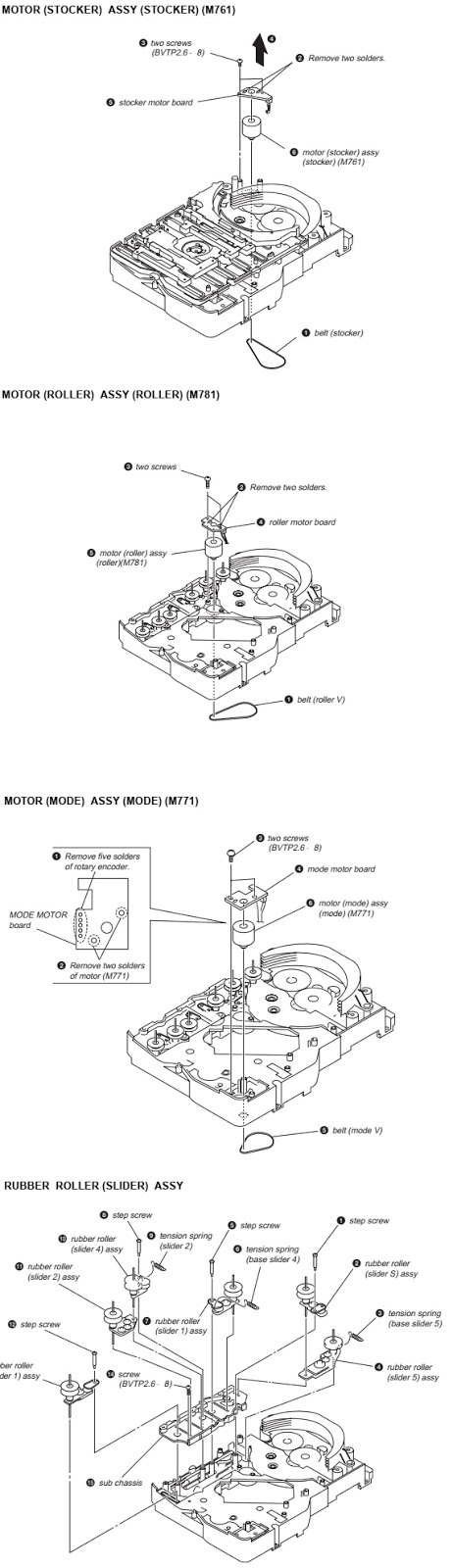
AIWA CX-BK7 DVD DECK RECEIVER HOW TO ASSEMBLE THE MECHANISM
CX-BK7 Aiwa DVD DECK RECEIVER How to assemble the mechanism
2 Engage the gear (eject lock) and the gear of the cam (eject lock) aligning the mark with the center of the gear (eject lock)
2 Align the mark on the cam (gear) with the boss as shown in the figure and install the cam (gear).
3 Install the gear (mode 2
2 Align mark A on the gear (mode cam) with mark B on the slider (mode cam) assy, then install the gear (mode cam).
3 Check that mark C on the gear (mode cam) is in alignment with mark D on the cam (gear).
Note: Push in the pinion (slider) until the claw of the boss comes out above the pinion (slider) to lock.
Saturday, 2 May 2020
AIWA CS 880E 3 BAND STEREO RADIO CASETTE RECORDER SCHEMATIC DIAGRAM - DESCRIPTION OF THE MD-3 MECHANISM – EXPLODED VIEW
Aiwa CS 880E Schematic diagram, 3 band stereo radio cassette recorder– exploded view – Vintage set
Description of the MD-3 mechanism
With the plate button pressed, the trigger lever (PLAY ) moves in the direction of the arrow <- (1), the gear (PLAY ) is released from the boss of the trigger lever (PLAY ) engages with the gear flywheel and rotates in the direction of the arrow <- (2), the boss (A) of the gear (PLAY ) touches the trigger lever (PLAY ) and the gear stops rotating.
When the gear (PLAY ) rotates, the lever (PLAY ) moves in the direction of the arrow <- (3) along the cam groove on the rear of the gear to push up the operation chassis in the direction of the arrow «- (4). The PLAY button which has been locked is released by pressing the STOP button, the trigger lever (PLAY ) moves in the direction of the arrow *- (5), the boss (A) of the gear (PLAY ) is released and the PLAY operation stops.
Description
of the FF Operation
When
the FF button is pressed, the trigger lever FF moves in the direction of the
arrow (1), the boss of the gear FR cam is released and engages with the gear
wheel to rotate in the direction of the arrow. <- (2), the boss (A ) touches
the boss of the trigger lever FF and the gear FR cam stops. The FR lever B
moves in the direction of the arrow «- (3) along the groove of the gear FR
cam, the FR lever B moves in the direction of the arrow <- (3), the FR
lever C compresses the gear of the FR lever Ass'y against the Take-up
reel disc ass'y to perform the FF operation.
REW
Operation
When
the
REW button is pressed, the trigger lever REW moves in the direction
of the arrow <- (1) and pushes the lever REW in the direction of the
arrow <- (2). The trigger lever FF releases the boss A of the gear at
that
time, the gear FR engages with the gear flywheel, rotates in the
direction of
the arrow <- (3), boss B touches the trigger lever FF and rotation
stops. The FR gear B is moved in the
direction the arrow «- (4) by means of the cam of the gear FR following the
rotation of the gear FR , pulls the FR lever C in the direction of the arrow
«- (5) and moves the FR lever ass'y in the direction of the arrow <- (6) to
rotate the Take-up reel disc reel disc ass'y to perform the R E W operation.
Description
of the PAUSE Operation
When
the PAUSE button is pressed, the trigger lever PAUSE moves in the
direction o f the arrow *- (1), the boss A of the gear PA U SE is released,
engages with the gear flywheel and rotates in the direction of the arrow <-
(2), the boss B touches the trigger PAUSE and rotation stops. The
PAUSE lever moves in the direction of
the arrow •*- (3) along the cam groove of the PAUSE gear at that time.
The PLAY idler lever and the pinch lever ass'y is moved to perform the
PAUSE operation
at that time.
When the PAUSE button is pressed again, the button is released from locking
and simultaneously the boss B of the gear PAUSE is released from the trigger
lever PAUSE and the PAUSE operation is released.
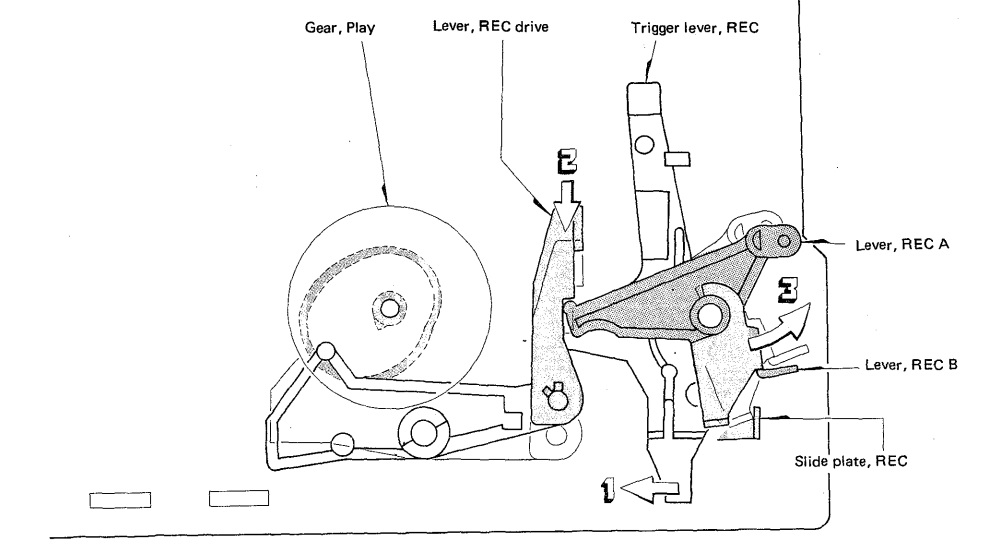
REC
Operation
When
the REC and PLAY buttons are pressed simultaneously, the trigger lever REC
moves in the direction of the arrow +- (1 ).
The PLAY operation is performed simultaneously at that time, so the REC
lever driver moves in the direction of the arrow «- (2),
pushes the lever RECA, B in the direction of the arrow <- (3), the
interlocked slide REC plate pulls the rod, the slide switch is operated and the
unit enters the R E C mode. When one of
the STOP, FF and REW buttons is pressed, the REC trigger lever is released
from the REC lever driver and only the REC operation is released.
Description
of the Auto-stop Operation
The
motor rotation is transmitted to the gear auto-kick of the MD-3 mechanism via
the slip pulley FR ass'y. The slip disk
presses the lever auto A in the direction of the arrow <- (1) when the
Take-up reel disc ass'y is rotating, so the boss of the lever auto A moves
along the cam (A) groove of the gear auto-kick.
When the reel discs (S, T sides) stop, the lever auto A stops in the condition
being moves in the direction of the arrow (2).
The cam (B) of the gear auto-kick moves the lever auto A in the direction
of the arrow «- (3), operates the plate auto-kick in the direction of the arrow
«- (4) to release the plate lock and performs the AUTO STOP operation.
Spring application position
Exploded view
Schematic diagram
Thursday, 9 April 2020
REPAIR / SERVICING TV AKIRA 32LED02T2M
Technical description and composition of the AKIRA 32LED02T2M TV, type of panel and applicable modules. The composition of the modules.AKIRA LED
Model: 32LED02T2M
Chassis / Version: TP.MS3463.SPB801
Panel: ST3151A04-9 Ver. 2.1
LED backlight: Direct LED
T-CON: MT3151A04-1-XC-C; AT6861AAQ, CS11103
LED driver (backlight): integrated into MainBoard
PWM LED driver: SN51DP
MOSFET LED driver: AOD458
Power Supply (PSU): integrated into MainBoard
PWM Power: PWM SOT23-6
MainBoard: TP.MS3463S.PB801
IC MainBoard: CPU: MSD3463GU, SPI Flash: 25Q64, AUDIO: OB6220VP
Tuner: XF-3SDT-H T3 / 1 R 1/648
Specifications 32LED02T2M
AKIRA 32LED02T2M
General repair guidelines for TV LCD LED
Possible malfunctions
- The AKIRA 32LED02T2M TV does not turn on and does not show any signs of operability at all. There is no reaction to the remote control and control buttons from the front panel.
In such cases, the common power source, the AC / DC voltage converter, which is combined with the elements of the main board TP.MS3463S.PB801, often turns out to be faulty. It is then necessary to measure its output voltages and, if they are absent, it is necessary to check the power switches and rectifier diodes of the converters for a short-circuit probability.
In case of diode breakdowns in the secondary circuits, the converter can operate in emergency short-circuit mode without output voltages, and during short circuit in the power elements of the primary circuit, the mains fuse and / or current sensor at the source of the key usually breaks.
Mos-Fet keys used in switching power supplies usually fail due to a malfunction of other elements that can put it out of operation in key mode or provoke an excess of the maximum current or voltage. These can be circuits supplying the PWM controller, damping or frequency-setting circuits, or elements of OOS (negative feedback) in the stabilization circuit. PWM controllers (PWM) PWM SOT23-6, in the absence of external damage and short circuit between the terminals, are checked by replacing with obviously good ones.
- There is no image, there is sound, it responds to the remote control, the channels are switched. In some cases, the image appears when you turn on and immediately disappears.
As a rule, in such cases there is no display backlight. The reason for this may be a break in the LED circuit, or a problem in stabilizing their power supply.
It is impossible to detect a break in the LED line without disassembling the panel with a simple multimeter. The LEDs are connected in series and to open their transitions, a voltage of several tens of volts is required. Ideally, a current source is suitable for such purposes. You can open the panel and check each LED separately. Typically, Chinese multimeters light up a single 3-volt LED, if you connect the probes in the forward direction to it (red probe to the anode, black to the cathode). In dual 6-volt LEDs, the PN junction of its emergency zener diode can serve as an indicator of health. In the event of a LED malfunction, its zener diode will either be cut off or broken into short-circuit.
- The indicator on the front panel blinks, the TV does not turn on in the operating mode, it does not respond to the remote control.
Repair or diagnostics of the TP.MS3463S.PB801 motherboard should begin by checking the stabilizers and power converters needed to power the chips and matrix. If necessary, update or replace the software (software). In cases of complex repairs of MB (SSB) and in the presence of the necessary skills and equipment, sometimes it may be necessary to replace its CPU chips: MSD3463GU, SPI Flash: 25Q64, AUDIO: OB6220VP and other possible faulty components. Malfunctions associated with the application of BGA soldering technologies are usually easily diagnosed by the heating method.
Before changing the tuner XF-3SDT-H T3 / 1 R 1/648, if it is not possible to tune to television channels, make sure that there are supply voltages that must be measured at the corresponding terminals of the tuner and check the software for correctness. The pulses of the data exchange of the tuner with the processor can be controlled by an oscilloscope
Owners of 32LED02T2M TVs are recommended to contact qualified specialists with the necessary work experience for repairs! Self-repair attempts without the appropriate knowledge and skills can lead to irreversible negative consequences!
SCHEMATIC DIAGRAM / SERVICE MANUAL ------------------> Trouble Shooting Chassis TP.MS3463S.PB801
FIRMWARE FOR SPI FLASH -----------> AKIRA 32LED02T2M, Main: TP.MS3463S.PB801, Panel: ST3151A04-9 Ver.2.1
The appearance of MainBoard TP.MS3463S.PB801 is shown in the figure below:TP.MS3463S.PB801
TP.MS3463S.PB801 can be used in TVs:
AKAI LEA-40V35M (Panel LSC400HM06), AKIRA 32LED38T2P (Panel ST3151A05-8), AKIRA 32LED02T2M (Panel ST3151A04-9 Ver.2.1), BBK 32LEM-1029/TS2C (Panel C320X16-E18-H), BBK 39LEM-1033/TS2C (Panel C390X15-E8-A G01), BBK 32LEM-1026/TS2C (Panel CX315DLEDM ST3151A05-8), BBK 32LEM-1027/TS2C (Panel ST3151A05-8 / CX315DLEDM), DEXP F43C7100K (Panel LC430DUY (SH)(A1)), DEXP F42B7000M (Panel V420HJ2-P01), DEXP F43C7000C (Panel C430F14-E1-L / LC430DUY), DEXP F40B7100K (Panel LSC400HN02-G02 40N06-L-HPX1F1), DEXP H28C7100C (Panel C275X15-E1-H (G31)), DEXP H32C7300K (Panel LSC320AN02), DEXP H32D7100C (Panel ST3151A05-8 Ver2.5), DEXP H28D7300K (Panel HV280WX2-260), ERISSON 32LES78T2W (Panel KM0320LDRH0037), ERISSON 32LEE30T2 (Panel LK315T3HB87-12V), SUPRA STV-LC32T560WL (Panel LSC320AN10), SUPRA STV-LC32T550WL (Panel LSC320AN02), SUPRA STV-LC40T500WL (Panel C39X15-E7-A), TELEFUNKEN TF-LED32S45T2 (Panel LK315T3HB87-12V), THOMSON T39D20DH-01B (Panel T390XVN01.0).
Key features of the AKIRA 32LED02T2M device:
Installed matrix (LED panel) ST3151A04-9 Ver. 2.1.
The matrix control uses the Timing Controller (T-CON) MT3151A04-1-XC-C ;.
To power the backlight LEDs, a converter is used, combined with the TP.MS3463S.PB801 main board, controlled by the SN51DP PWM controller. As power elements of the LED driver, keys of the AOD458 type are used.
The power module is combined with the MainBoard and is made according to the flyback AC / DC voltage converter circuit using PWM SOT23-6 microcircuits.
MainBoard - the main board (motherboard) is a TP.MS3463S.PB801 module, using CPU chips: MSD3463GU, SPI Flash: 25Q64, AUDIO: OB6220VP and others.
Tuner XF-3SDT-H T3 / 1 R 1/648 provides the reception of television programs and tuning to channels.
Brand: AKIRA, Model: 32LED02T2M.
Shortly from the TV: LCD, LED backlight, 31.5 ", 1366x768, 720p HD, sound: 12 W, HDMI connectors: 3.
The composition uses MainBoard TP.MS3463S.PB801 and LCD-panel ST3151A04-9 Ver. 2.1. The power supply is combined with the MainBoard.
TV AKIRA 32LED02T2M with LCD ST3151A04-9, diagonal size 31.5 "(80 cm) in 16: 9 format. The declared brightness of the screen is 200 cd / m² with modern LED backlight LED. The ratio of maximum brightness to minimum (contrast) is not less than 3000 : 1. Direct LED backlighting is used in the LCD panel - Direct LED, HD viewing at 1366x768 pixels in 720p standard (HD Ready) is possible. Multimedia formats are supported: MP3, MPEG4, MKV, JPEG.
The power of the sound system 12 W (2x6 W) provides two speakers. The audio processing system NICAM STEREO is used.
The external interface (communication with other devices) is supported by standard input and output connectors: antenna input (RF), AV, component, VGA, HDMI x3, USB. A headphone jack is provided. A digital tuner is capable of receiving television channels in the DVB-T MPEG4, DVB-C, DVB-T2 standards.
Overall dimensions: with stand 730x477x140 mm, without stand 730x437x85 mm.
TV Weight: with stand: 4.54 kg, without stand: 4.4 kg.
Attention! The ST3151A04-9 Ver.2.1 panel of the AKIRA 32LED02T2M LED TV is an expensive and unreliable element.
Avoid any impact on the glass and pressure on the surface of the screen to avoid damage to the LED panel!
It is also unsafe to get liquid on the screen. Sometimes one drop is enough if it flows down the glass onto the cables so that the TV becomes unrepairable.
REPAIR / SERVICING TV AIWA 47LE71213
Technical description and composition of the TV AIWA 47LE71213, type of panel and applicable modules. The composition of the modules.AIWA LED
Model: 47LE71213
Chassis / Version: 5800-A5M91T-0P10
Panel: LC470EUJ (SF) (K2)
T-CON: 168P-P47DWM-W2
LED driver (backlight): integrated into PSU
Power Supply (PSU): 5800-P47ELL-W010
PWM Power: TEA1755T
MOSFET Power: 18N50, 2SK3673
MainBoard: 5800-A5M91T-0P10 Ver00.01
IC MainBoard: CPU: MSD6369IV, SPI Flash: 25Q16, Nand: TNGBM4G4D1HBAIR
Tuner: NoName
Specifications 47LE71213
AIWA 47LE71213
General repair guidelines for TV LCD LED
Possible malfunctions
- The AIWA 47LE71213 TV does not turn on at all. There is no reaction to the remote control and control buttons from the front panel. Indicator lights do not light or flash.
Most often, with such manifestations, the main power module 5800-P47ELL-W010 is found to be faulty. In the absence of the necessary supply voltages in the secondary circuits of the converters, it is necessary to check the power switches (18N50, 2SK3673) and rectifier diodes for a possible partial or complete breakdown.
In case of any breakdowns in the secondary circuits, the converter can operate in emergency short circuit mode, and during short circuit in the power elements of the primary circuit, the mains fuse or the current sensor at the source of the key more often breaks.
Mos-Fet power switches, used in switching power supplies, sometimes fail due to a malfunction of any other elements that can put it out of operation in key mode or create an excess of the maximum permissible parameters of the switch. These can be elements supplying the PWM controller, frequency-setting or damping circuits, or negative feedback elements in the stabilization circuit. TEA1755T PWM controllers, in the absence of visible damage or obvious short-circuit between the terminals, are checked by replacing with new ones, or obviously working.
- There is no image, but there is sound and reaction to the remote control. Or for a second, the image may appear immediately after switching on.
In most of these cases, a malfunction is detected in the nodes and backlight elements of the LED panel. The reason for this may be a break in the LED circuit, or a problem in stabilizing their power supply.
When diagnosing, it is necessary to take into account that it is impossible to check the open in the chain of LED lines without disassembling the panels using a tester or multimeter. To open all PN junctions connected in series, a voltage of the order of several tens of volts is required, and ideally, a current source. By opening the panel, each LED can be checked separately. Typically, Chinese multimeters light up a single 3-volt LED, if you connect probes in the forward direction to it. In dual 6-volt LEDs, the PN junction of its emergency zener diode can serve as an indicator of health. In the event of a LED malfunction, its zener diode will either be cut off or broken into short-circuit.
- The TV does not turn on, does not respond to the remote control. The indicator blinks or signals standby mode.
Repair or diagnostics of the 5800-A5M91T-0P10 motherboard should begin by checking the stabilizers and power converters needed to power the chips and matrix. If necessary, update or replace the software (software). In cases of complex repairs of MB (SSB) and in the presence of the necessary skills and equipment, sometimes it may be necessary to replace its 25Q16 chips and other possible faulty components. Malfunctions associated with the application of BGA soldering technologies are usually easily diagnosed by the heating method.
If a NoName tuner is suspected of a malfunction, first of all, it is necessary to verify the correctness of the software, as well as the presence of the necessary supply voltage levels and data exchange pulses with the processor via the I2C bus at the corresponding tuner pins.
It should be remembered! Attempts to self-repair the TV AIWA 47LE71213, in the absence of the necessary qualifications and experience, are categorically not recommended and are fraught with negative consequences, up to the complete non-repairability of the device!
The appearance of the MainBoard 5800-A5M91T-0P10 is shown in the figure below:5800-A5M91T-0P10
5800-A5M91T-0P10 can be used in TVs:
AIWA 47LE71213 (Panel LC470EUJ (SF)(K2)), SUPRA STV-LC47S660FL00 (Panel LC470EUJ-SFK2 1920x1080).
The appearance of the power supply
Key Features of AIWA 47LE71213:
Installed matrix (LED-panel) LC470EUJ (SF) (K2).
The matrix control uses the Timing Controller (T-CON) 168P-P47DWM-W2.
To power the backlight LEDs, a converter is used, combined with a power supply.
The necessary supply voltages for all nodes of the TV AIWA 47LE71213 are generated by the power module 5800-P47ELL-W010, or its analogs using TEA1755T microcircuits and power switches of the type 18N50, 2SK3673.
MainBoard - the main board (motherboard) is a 5800-A5M91T-0P10 module, using CPU chips: MSD6369IV, SPI Flash: 25Q16, Nand: TNGBM4G4D1HBAIR and others.
The NoName tuner provides television reception and channel tuning.
Additional technical information about the panel:
Brand: LG Display
Model: LC470EUJ-SFK2
Type: a-Si TFT-LCD, CELL
Diagonal size: 47 inch
Resolution: 1920x1080, FHD
Display Mode: IPS, Normally Black, Transmissive
Active Area: 1039.68x584.82 mm
Surface: Antiglare (Haze 1%), Hard coating (2H)
Glass Depth: 0.50 + 0.50 mm
Transmissivity: 5.87% (with Polarizer)
Contrast Ratio: 1200: 1
Display Colors: 16.7M (8-bit)
Response Time: 6 (G to G)
Frequency: 60Hz
Signal Interface: LVDS (2 ch, 8-bit), 51 pins
Voltage: 12.0V
Trademark: AIWA, Model: 47LE71213.
Shortly from the TV: LCD, LED backlight, 47 ", 1920x1080, 1080p Full HD, 3D, sound: 16W, HDMI: 4, Wi-Fi, Smart TV.
The composition includes MainBoard 5800-A5M91T-0P10 Ver00.01 and LCD panel (matrix) LC470EUJ (SF) (K2).
Power Supply Unit (PSU) 5800-P47ELL-W010 Power Supply.
AIWA 47LE71213 TV with an LCD display LC470EUJ, diagonal size 47 "(119 cm) in 16: 9 format. The required brightness of the screen is 360 cd / m² LED backlight LED. Dynamic contrast ratio 120,000: 1 is achieved by special control of the LEDs. In manufacturing technology The display of this model is implemented LED backlight.
There is support for 3D images with active (shutter) technology for separating the right and left channels.
The LC470EUJ (SF) (K2) panel and the software of the 5800-A5M91T-0P10 motherboard provide viewing of broadcasts and films in high quality HD with a resolution of 1920x1080 pixels in a graphical decomposition according to the standard 1080p (Full HD).
The 47LE71213 TV model has built-in SMART software and the installed Android Operating System. Connecting to a network can be done via Wi-Fi. The input high-frequency or video signal can be processed in analogue systems PAL, SECAM, NTSC. Graphic processing and digital signal generation occurs in standards 480i, 480p, 576i, 576p, 720p, 1080i, 1080p.
Supported media file formats: MP3, WMA, MPEG4, MKV, JPEG.
The power of the sound system 16 W (2x8 W) provide two speakers. The audio processing system NICAM STEREO is used.
The external interface (communication with other devices) is supported by standard input and output connectors: antenna input (RF), AV, audio x2, component, VGA, HDMI x4, MHL, USB x2, Wi-Fi. An output for connecting headphones is provided. To connect a computer or laptop to this TV model, a VGA (D-Sub 15) connector is used on the TV case, this interface supports resolutions: 640x480, 800x600, 1024x768, 1280x1024, 1360x768, 1920x1080. A digital tuner is capable of receiving television channels in the DVB-T MPEG4, DVB-C, DVB-T2 standards.
The power consumed by the TV working in the network mode is 140 watts.
Overall dimensions: without stand 1024x639x62 mm.
Attention! The panel of the LC470EUJ (SF) (K2) AIWA 47LE71213 LED TV is an expensive and unreliable element.
Avoid any impact on the glass and pressure on the surface of the screen to avoid damage to the LED panel!
It is also unsafe to get liquid on the screen. Sometimes one drop is enough if it flows down the glass onto the cables so that the TV becomes unrepairable.
REPAIR / SERVICING TV AIWA 47LE61103
Technical description and composition of the TV AIWA 47LE61103, panel type and applicable modules. The composition of the modules.AIWA LED
Model: 47LE61103
Chassis / Version: V1L09
Panel: LC470EUN (SE) (F1)
LED backlight: EDGE LED
T-CON: 6870C-0401B
LED driver (backlight): integrated into Panel
Power Supply (PSU): 168P-P47EEL-W1
MainBoard: 5800-A8M480-0P10
IC MainBoard: EN25Q32
Tuner: ET9Z2E-CF106H
Specifications 47LE61103
AIWA 47LE61103
General repair guidelines for TV LCD LED
Possible malfunctions
- The AIWA 47LE61103 TV does not turn on, does not respond to the remote control and the control panel buttons, does not light up or blink indicators.
In such cases, the 168P-P47EEL-W1 power supply is usually faulty. In the absence of the necessary supply voltages in the secondary circuits of the converters, it is necessary to check the power switches and rectifier diodes for a possible partial or complete breakdown.
In case of breakdowns in the secondary circuits, the converter can operate in a short circuit mode, and during a short circuit in the elements of the primary circuit, the mains fuse usually breaks.
The breakdown of Mos-Fet keys used in pulsed sources is often caused by malfunctions of other elements, for example, in the power supply circuit of a PWM controller, in frequency-setting or damping circuits, as well as in Negative Stabilization Feedback. PWM microcircuits are usually checked by replacement with new ones, or obviously working.
- There is no image, but there is sound, it reacts to the remote control. Or the image appears when you turn it on and immediately disappears
A malfunction is usually most likely in these cases at the backlight nodes of the display matrix. The reason for this may be a break in the LED circuit, or a problem in stabilizing their power supply.
To check the LED strips, to open all the transitions of the LEDs, several tens of volts or more are needed, it is best to use a current source for such purposes. The breakage of several PN junctions connected in series cannot be detected with a multimeter or tester. In such cases, it is necessary to open the panel and check each LED. If your multimeter cannot open the LED transitions in forward bias, you can sometimes detect the presence of a PN junction of the protective zener diode by connecting the probes in the opposite direction. If the zener diode is broken or broken in short-circuit, then the LED is faulty and needs to be replaced.
- The indicator blinks or lights constantly, the TV does not turn on, does not respond to the remote control.
Repair or diagnostics of the 5800-A8M480-0P10 motherboard should be started by checking the stabilizers and power converters needed to power the microcircuits and matrix. If necessary, update or replace the software (software). Sophisticated MB board repair (SSB) is in some cases possible and practiced by repairmen. To do this, check and, if necessary, replace the elements of EN25Q32. BGA chip malfunctions are usually easy to detect by warming up.
If the TV works normally from external devices, but does not tune into television channels, the tuner ET9Z2E-CF106H may be malfunctioning. In such cases, first of all, you should make sure that there are supply voltages at its corresponding conclusions. It is also necessary to make sure that the tuner and processor can exchange data via the I2C bus. Sometimes the cause of the inoperability of the tuner may be a software failure.
It should be remembered! Attempts to independently repair the TV AIWA 47LE61103, in the absence of the necessary qualifications and experience, are categorically not recommended and are fraught with negative consequences, up to the complete non-repairability of the device!
FIRMWARE FOR SPI FLASH -----------> AIWA 47LE61103 V1L09, Main: 5800-A8M480-0P10, Panel: LC470EUN (SE)(F1)

The appearance of the MainBoard 5800-A8M480-0P10 is shown in the figure below:
5800-A8M480-0P10
5800-A8M480-0P10 can be used in TVs:
AIWA 47LE61103 (Panel LC470EUN (SE)(F1)), AIWA 42LE6110 (Panel LC420EUN (SE)(M1)), AIWA 39LE6110 (Panel V390HJ1-P01), ERISSON 42LES66 (Panel LC420EUN SEM1), ERISSON 39LES66 (Panel CX275DLEDM), ERISSON 32LES66 (Panel REL320AH-U100 Rev.00), SUPRA STV-LC39660FL (Panel V390HJ1 rev.c1 SEL390V7-S00D ), SUPRA STV-LC32663FL (Panel T320HVN01.2), SUPRA STV-LC39663FL (Panel V390HJ1-P01), SUPRA STV-LC47660FL00 (Panel LC470EUN).
Key Features of AIWA 47LE61103:
Installed matrix (LED-panel) LC470EUN (SE) (F1).
The matrix control uses the Timing Controller (T-CON) 6870C-0401B.
An integrated LED driver is used to power the backlight LEDs.
The necessary supply voltages for all nodes of the TV AIWA 47LE61103 are formed by the power supply module 168P-P47EEL-W1, or its analogs.
MainBoard - the main board (motherboard) is a 5800-A8M480-0P10 module, using EN25Q32 chips and others.
Tuner ET9Z2E-CF106H provides the reception of television programs and tuning to channels.
Additional technical information about the panel:
Brand: LG Display
Model: LC470EUN-SEF1
Type: a-Si TFT-LCD, Panel
Diagonal size: 47 inch
Resolution: 1920x1080, FHD
Display Mode: S-IPS, Normally Black, Transmissive
Active Area: 1039.68x584.82 mm
Surface: Antiglare (Haze 1%), Hard coating (2H)
Brightness: 360 cd / m²
Contrast Ratio: 1400: 1
Display Colors: 16.7M (8-bit), CIE1931 68%
Response Time: 6 (G to G)
Frequency: 60Hz
Lamp Type: WLED Embedded (LED Driver)
Signal Interface: LVDS (2 ch, 8-bit), 51 pins
Voltage: 12.0V
Trademark: AIWA, Model: 47LE61103.
Short from TV: LCD, LED backlight, 47 ", 1920x1080, 1080p Full HD, 3D, sound: 24W, HDMI: 3.
The composition uses the MainBoard 5800-A8M480-0P10 and the LCD panel (matrix) LC470EUN (SE) (F1).
Power Supply Unit (PSU) 168P-P47EEL-W1 Power Supply.
AIWA 47LE61103 TV with an LCD display LC470EUN, diagonal size 47 "(119 cm) in 16: 9 format. The required brightness of the screen is 360 cd / m² LED backlight LED. Dynamic contrast ratio 120,000: 1 is achieved by special control of the LEDs. In this model Edge LED is used for side lighting. Yes, 2D to 3D conversion
The LC470EUN (SE) (F1) panel and the 5800-A8M480-0P10 motherboard software provide for watching programs and movies in high quality HD at a resolution of 1920x1080 pixels in a graphical decomposition according to the standard 1080p (Full HD). The input high-frequency or video signal can be processed in analogue systems PAL, SECAM, NTSC. Graphic processing and digital signal generation occurs in standards 480i, 480p, 576i, 576p, 720p, 1080i, 1080p.
Supported media file formats: MP3, MKV, JPEG.
The power of the sound system 24 W (2x12 W) provides two speakers. The audio processing system NICAM STEREO is used.
The external interface (communication with other devices) is supported by standard input and output connectors: antenna input (RF), AV, component, VGA, HDMI x3, USB x2. An output for connecting headphones is provided. To connect a computer or laptop to this TV model, a VGA (D-Sub 15) connector is used on the TV case, this interface supports resolutions: 640x480, 1024x768, 1280x1024, 1360x768, 1920x1080.
The power consumed by the TV working in the network mode is 140 watts.
Overall dimensions: 1174x760x166 mm.
TV Weight: 21.1 kg.
Attention! The panel of the LC470EUN (SE) (F1) AIWA 47LE61103 LED TV is an expensive and unreliable element.
Avoid any impact on the glass and pressure on the surface of the screen to avoid damage to the LED panel!
It is also unsafe to get liquid on the screen. Sometimes one drop is enough if it flows down the glass onto the cables so that the TV becomes unrepairable.
REPAIR / SERVICING TV AIWA 47LE71113
Technical description and composition of the TV AIWA 47LE71113, type of panel and applicable modules. The composition of the modules.AIWA LED
Model: 47LE71113
Chassis / Version: V1N03 chassis 8M51B
Panel: LC470EUJ-SFK2 (SEL470FY)
LED driver (backlight): 168P-P47DWM-W2 5800-P47DWM-W200 VER00.00
Power Supply (PSU): 168P-P47ELL-W1 5800-P47ELL-W000
PWM Power: TEA1752 (PFC + PWM)
MOSFET Power: 18N50, 2SK3673
MainBoard: 5800-A8M51B-0000 Ver00.07
IC MainBoard: CPU: MSD6329SV, Eeprom: K24C04, SPI Flash: 25L1606E (MX25L1605A), NAND Flash: TC58NVG1S3ETA00
Tuner: TDST-G070D
Specifications 47LE71113
AIWA 47LE71113
General repair guidelines for TV LCD LED
Possible manifestations of defects
- AIWA 47LE71113 TV does not turn on at all. There is no reaction to the remote control and control buttons from the front panel. Indicator lights do not light or flash.
Failure in such cases should begin to be sought in the power supply circuits of 168P-P47ELL-W1. It is necessary to measure its output voltages and, in case of their absence, check the serviceability of power switches (18N50, 2SK3673) and rectifier diodes in the converters for possible breakdown.
In case of breakdowns in the secondary circuits, the converter, as a rule, can emergency work in the short circuit mode, and during short circuit in the power elements of the primary circuit, the mains fuse usually breaks.
Breakdown of power switches (MosFet) in pulsed sources is sometimes caused by malfunctions of other circuit elements, for example, in circuits supplying a PWM controller, frequency-setting or damper ones, as well as in negative feedback (OOS) stabilization circuits. PWM controllers (PWM) TEA1752 (PFC + PWM), if they do not have visible damage to the case and open fault between the terminals, are usually checked by replacement.
- There is no image, there is sound, it is responding to the remote control. Or immediately after turning on for a second, the image may appear and immediately disappear.
As a rule, in such cases there is no display backlight. The reason can be both in the power supply of the LEDs, in their serviceability (breakdown or breakage), as well as in the violation of the contact connections of the LED strips.
To check the LED strips, to open all the transitions of the LEDs, several tens of volts or more are needed, it is best to use a current source for such purposes. The breakage of several PN junctions connected in series cannot be detected with a multimeter or tester. In such cases, it is necessary to open the panel and check each LED. If your multimeter cannot open the LED transitions in forward bias, you can sometimes detect the presence of a PN junction of the protective zener diode by connecting the probes in the opposite direction. If the zener diode is broken or broken in short-circuit, then the LED is faulty and needs to be replaced.
- The indicator blinks or lights constantly, the TV does not turn on, does not respond to the remote control.
Repair or diagnostics of the 5800-A8M51B-0000 motherboard should begin by checking the stabilizers and power converters needed to power the chips and matrix. If necessary, update or replace the software (software). In cases of complex repairs of MB (SSB) and in the presence of the necessary skills and equipment, sometimes it may be necessary to replace its CPU chips: MSD6329SV, Eeprom: K24C04, SPI Flash: 25L1606E (MX25L1605A), NAND Flash: TC58NVG1S3ETA00 and other possible faulty components. Malfunctions associated with the application of BGA soldering technologies are usually easily diagnosed by the heating method.
If a TDST-G070D tuner is suspected of malfunction, first of all, it is necessary to verify the correctness of the software, as well as the presence of the necessary supply voltage levels and data exchange pulses with the processor via the I2C bus on the corresponding tuner pins.
Owners and users of the AIWA 47LE71113 TV should remember that self-repair without special knowledge, skills and qualifications can be fraught with negative consequences that can lead to complete non-repairability of the device!
SCHEMATIC DIAGRAM / SERVICE MANUAL ------------------> 168P-P47ELL ... 5800-P47ELL ... Power supply
FIRMWARE FOR SPI FLASH -----------> AIWA 47LE71113 V1N03, Main: 5800-A8M51B-0000, Panel: LC470EUJ-SFK2
FIRMWARE FOR SPI FLASH -----------> AIWA 47LE71113 V1M12 , Main: 5800-A8M51B-0000
The appearance of the MainBoard 5800-A8M51B-0000 is shown in the figure below:5800-A8M51B-0000
5800-A8M51B-0000 can be used in TVs:
AIWA 47LE71113 (Panel LC470EUJ-SFK2 (SEL470FY)), AIWA 32LE7011 (Panel REL320HY (LD0-000) Rev:00).
The appearance of the power supply
Key Features of AIWA 47LE71113:
Installed matrix (LED panel) LC470EUJ-SFK2 (SEL470FY).
The LED driver 168P-P47DWM-W2 is used to power the backlight LEDs.
The necessary supply voltages for all nodes of the TV AIWA 47LE71113 are generated by the 168P-P47ELL-W1 power supply module or its analogs using TEA1752 microcircuits (PFC + PWM) and power switches of the 18N50, 2SK3673 type.
MainBoard - the main board (motherboard) is a 5800-A8M51B-0000 module, using CPU chips: MSD6329SV, Eeprom: K24C04, SPI Flash: 25L1606E (MX25L1605A), NAND Flash: TC58NVG1S3ETA00 and others.
The TDST-G070D tuner provides television reception and channel tuning.
Additional technical information about the panel:
Brand: LG Display
Model: LC470EUJ-SFK2
Type: a-Si TFT-LCD, CELL
Diagonal size: 47 inch
Resolution: 1920x1080, FHD
Display Mode: IPS, Normally Black, Transmissive
Active Area: 1039.68x584.82 mm
Surface: Antiglare (Haze 1%), Hard coating (2H)
Glass Depth: 0.50 + 0.50 mm
Transmissivity: 5.87% (with Polarizer)
Contrast Ratio: 1200: 1
Display Colors: 16.7M (8-bit)
Response Time: 6 (G to G)
Frequency: 60Hz
Signal Interface: LVDS (2 ch, 8-bit), 51 pins
Voltage: 12.0V
Trademark: AIWA, Model: 47LE71113.
Briefly from the TV: LCD, LED backlight, 47 ", 1920x1080, 1080p Full HD, 3D, sound: 24W, HDMI: 4, Wi-Fi, Smart TV.
The composition includes MainBoard 5800-A8M51B-0000 Ver00.07 and LCD panel (matrix) LC470EUJ-SFK2 (SEL470FY).
Power Supply Unit (PSU) 168P-P47ELL-W1 5800-P47ELL-W000 Power Supply.
AIWA 47LE71113 TV with LC470EUJ-SFK2 LCD display, 47 "(119 cm) diagonal size in 16: 9 format. The required screen brightness of 360 cd / m² is provided by LED backlighting. Dynamic contrast ratio of 120,000: 1 is achieved by special control of the LEDs. V manufacturing technology of the display of this model implemented LED backlight.
There is support for 3D images with active (shutter) technology for separating the right and left channels.
The LC470EUJ-SFK2 (SEL470FY) panel and the 5800-A8M51B-0000 motherboard software provide for watching programs and movies in high quality HD at a resolution of 1920x1080 pixels in a graphical decomposition according to the standard 1080p (Full HD).
47LE71113 is equipped with SMART software and the ability to work on the Internet. Connecting to a network can be done via Wi-Fi. The input high-frequency or video signal can be processed in analogue systems PAL, SECAM, NTSC. Graphic processing and digital signal generation occurs in standards 480i, 480p, 576i, 576p, 720p, 1080i, 1080p.
Supported media file formats: MP3, WMA, MPEG4, MKV, JPEG.
The power of the sound system 24 W (2x12 W) provides two speakers. The audio processing system NICAM STEREO is used.
The external interface (communication with other devices) is supported by standard input and output connectors: antenna input (RF), AV, audio x2, component, VGA, HDMI x4, USB x2, Wi-Fi. An output for connecting headphones is provided. To connect a computer or laptop to this TV model, a VGA (D-Sub 15) connector is used on the TV case, this interface supports resolutions: 640x480, 800x600, 1024x768, 1280x1024, 1360x768, 1920x1080.
Overall dimensions: without stand 1024x639x62 mm.
Attention! Panel LC470EUJ-SFK2 (SEL470FY) LED-TV AIWA 47LE71113 is an expensive and unreliable element.
Avoid any impact on the glass and pressure on the surface of the screen to avoid damage to the LED panel!
It is also unsafe to get liquid on the screen. Sometimes one drop is enough if it flows down the glass onto the cables so that the TV becomes unrepairable.
REPAIR / SERVICING TV AIWA 42LE71213
Technical description and composition of the TV AIWA 42LE71213, type of panel and applicable modules. The composition of the modules.AIWA LED
Model: 42LE71213
Chassis / Version: V1N10
Panel: LC420EUJ- (SF) (K2)
LED backlight: SEL420FY (LDF-200) -X2 - B / A
LED driver (backlight): integrated into PSU
Power Supply (PSU): 5800-P47ELL-W010
PWM Power: TEA1755T
MOSFET Power: 18N50, 2SK3673
MainBoard: 5800-A5M91T-0P10
IC MainBoard: CPU: MSD6369IV, SPI Flash: 25Q16, Nand: TNGBM4G4D1HBAIR
Specifications 42LE71213
AIWA 42LE71213
General repair guidelines for TV LCD LED
Possible malfunctions
- The AIWA 42LE71213 TV does not turn on and does not show any signs of turning on, it does not respond to the control buttons or to the remote control.
In such cases, the main power source - the AC / DC voltage converter, which is combined with the MainBoard 5800-A5M91T-0P10 board, may turn out to be faulty. It is necessary to measure its output voltages, and in case of their absence (full or partial), it is necessary to check the serviceability of power switches (18N50, 2SK3673) of converters and rectifier diodes for the presence of a possible short circuit.
In case of breakdowns of semiconductors in the secondary circuits of any converter, as a rule, it can operate in emergency short-circuit mode without output voltages, and during short circuit in the elements of the primary circuit, the main fuse and, less often, the current sensor at the source of the key are most often cut off.
Mos-Fet power switches, used in switching power supplies, sometimes fail due to a malfunction of any other elements that can put it out of operation in key mode, or create an excess of the maximum permissible parameters of the switch. These can be elements supplying the PWM controller, frequency-setting or damping circuits, or negative feedback elements in the stabilization circuit. TEA1755T PWM controllers, in the absence of visible damage or obvious short-circuit between the terminals, are checked by replacing with new ones, or obviously working.
- There is no image, there is sound, it responds to the remote control. Or the image may appear for a second when turned on and immediately disappears.
In some of these cases, the malfunction is caused by a lack of backlighting on the display. The reason for this may be a break in the LED circuit, or a problem in stabilizing their power supply.
It is impossible to detect a break in the LED line without disassembling the panel with a simple multimeter. The LEDs are connected in series and to open their transitions, a voltage of several tens of volts is required. Ideally, a current source is suitable for such purposes. You can open the panel and check each LED separately. Typically, Chinese multimeters light up a single 3-volt LED, if you connect the probes in the forward direction to it (red probe to the anode, black to the cathode). In dual 6-volt LEDs, the PN junction of its emergency zener diode can serve as an indicator of health. In the event of a LED malfunction, its zener diode will either be cut off or broken into short-circuit.
- The TV does not enter the operating mode, does not respond to the remote control. The indicator on the front panel lights constantly or blinks.
Repair or diagnostics of the 5800-A5M91T-0P10 motherboard should begin by checking the stabilizers and power converters needed to power the chips and matrix. If necessary, update or replace the software (software). Often, the MB (SSB) card must be replaced in case of complex malfunctions that are difficult to detect. When trying to repair, you should check its elements - CPU: MSD6369IV, SPI Flash: 25Q16, Nand: TNGBM4G4D1HBAIR and replace failed chips with new ones. Some malfunctions may be due to the use of BGA soldering technologies in modern Main Board technologies. Typically, such defects are detected by local heating of the chip.
Once again, remind users! Attempts to self-repair the TV AIWA 42LE71213 without the appropriate qualifications and the necessary experience can lead to its complete non-repairability!
FIRMWARE FOR SPI FLASH -----------> AIWA 42LE71213 V1N10, Main: 5800-A5M91T-0P10, Panel: LC420EUJ-(SF)(K2)
The appearance of the MainBoard 5800-A5M91T-0P10 is shown in the figure below:5800-A5M91T-0P10
5800-A5M91T-0P10 can be used in TVs:
AIWA 47LE71213 (Panel LC470EUJ (SF)(K2)), SUPRA STV-LC47S660FL00 (Panel LC470EUJ-SFK2 1920x1080).
The appearance of the power supply
Key Features of AIWA 42LE71213:
Installed matrix (LED-panel) LC420EUJ- (SF) (K2).
To power the backlight LEDs, a converter is used, combined with a power supply.
The necessary supply voltages for all nodes of the TV AIWA 42LE71213 are generated by the power supply module 5800-P47ELL-W010, or its analogs using TEA1755T microcircuits and power switches of the 18N50, 2SK3673 type.
MainBoard - the main board (motherboard) is a 5800-A5M91T-0P10 module, using CPU chips: MSD6369IV, SPI Flash: 25Q16, Nand: TNGBM4G4D1HBAIR and others.
Additional technical information about the panel:
Brand: LG Display
Model: LC420EUJ-SFK2
Type: a-Si TFT-LCD, CELL
Diagonal size: 42 inch
Resolution: 1920x1080, FHD
Display Mode: IPS, Normally Black, Transmissive
Active Area: 927.94x521.96 mm
Surface: Antiglare (Haze 1%), Hard coating (2H)
Glass Depth: 0.50 + 0.50 mm
Transmissivity: 6.35% (with Polarizer)
Contrast Ratio: 1200: 1
Display Colors: 16.7M (8-bit)
Response Time: 6 (G to G)
Frequency: 60Hz
Signal Interface: LVDS (2 ch, 8-bit), 51 pins
Voltage: 12.0V
Trademark: AIWA, Model: 42LE71213.
Briefly from the TV: LCD, LED backlight, 42 ", 1920x1080, 1080p Full HD, 3D, sound: 16W, HDMI: 3, Wi-Fi, Smart TV.
The composition uses MainBoard 5800-A5M91T-0P10 and LCD Panel LC420EUJ-SFK2. Backlight: Edge LED. Version V1N10
AIWA 42LE71213 TV with an LCD display LC420EUJ-SFK2, diagonal size 42 "(107 cm) in 16: 9 format. The required brightness of the screen is 360 cd / m² LED backlight LED. Dynamic contrast ratio 120,000: 1 is achieved by special control of the LEDs. V manufacturing technology of the display of this model is implemented LED backlight. is, 2D to 3D conversion
The LC420EUJ-SFK2 panel and the software of the 5800-A5M91T-0P10 motherboard provide viewing of broadcasts and films in high quality HD at a resolution of 1920x1080 pixels in a graphical decomposition according to the standard 1080p (Full HD).
42LE71213 is equipped with SMART software and the ability to work on the Internet. Connecting to a network can be done via Wi-Fi. The input high-frequency or video signal can be processed in analogue systems PAL, SECAM, NTSC. Graphic processing and digital signal generation takes place in the standards 480i, 480p, 576i, 576p, 720p, 1080i, 1080p.
Supported media file formats: MP3, MPEG4, MKV, JPEG.
The power of the sound system 16 W (2x8 W) provide two speakers. The audio processing system NICAM STEREO is used.
The external interface (communication with other devices) is supported by standard input and output connectors: antenna input (RF), AV, audio x2, component, VGA, HDMI x3, MHL, USB x4, Wi-Fi. An output for connecting headphones is provided. To connect a computer or laptop to this TV model, a VGA (D-Sub 15) connector is used on the TV case, this interface supports resolutions: 640x480, 800x600, 1024x768, 1280x1024, 1360x768, 1920x1080. A digital tuner is capable of receiving television channels in the DVB-T MPEG4, DVB-C, DVB-T2 standards.
The power consumed by the TV working in the network mode is 120 watts.
Overall dimensions: without stand 965x577x53 mm.
TV mass: without stand: 14.8 kg.
Attention! Panel LC420EUJ-SFK2 LED-TV AIWA 42LE71213 is an expensive and unreliable element.
Avoid any impact on the glass and pressure on the surface of the screen to avoid damage to the LED panel!
It is also unsafe to get liquid on the screen. Sometimes one drop is enough if it flows down the glass onto the cables so that the TV becomes unrepairable.