REPAIRING AND NOT THROWING AWAY

Richtige Fernseher haben Röhren!

Richtige Fernseher haben Röhren!

In Brief: On this site you will find pictures and technical information about Service Modes, Circuit Diagrams, Firmware Update procedure, Disassemble procedure, Universal remote control set-up codes, Troubleshooting and more....

If you go into the profession, you will obtain or have access to a variety of tech tips databases HERE IT IS Master Electronics Repair !.

These are an excellent investment where the saying: 'time-is-money' rules. However, to learn, you need to develop a general troubleshooting approach - a logical, methodical, method of narrowing down the problem. A tech tip database might suggest: 'Replace C536' for a particular symptom. This is good advice for a specific problem on one model. However, what you really want to understand is why C536 was the cause and how to pinpoint the culprit in general even if you don't have a service manual or schematic and your tech tip database doesn't have an entry for your sick TV or VCR.

While schematics are nice, you won't always have them or be able to justify the purchase for a one-of repair. Therefore, in many cases, some reverse engineering will be necessary. The time will be well spent since even if you don't see another instance of the same model in your entire lifetime, you will have learned something in the process that can be applied to other equipment problems.
As always, when you get stuck, checking out a tech-tips database may quickly identify your problem and solution.In that case, you can greatly simplify your troubleshooting or at least confirm a diagnosis before ordering parts.

Happy repairing!
Today, the West is headed for the abyss. For the ultimate fate of our disposable society is for that society itself to be disposed of. And this will happen sooner, rather than later.

How to use the site:

- If you landed here via any Search Engine, you will get what you searched for and you can search more using the search this blog feature provided by Google. You can visit more posts scrolling the left blog archive of all posts of the month/year,
or you can click on the main photo-page to start from the main page. Doing so it starts from the most recent post to the older post simple clicking on the Older Post button on the bottom of each page after reading , post after post.

You can even visit all posts, time to time, when reaching the bottom end of each page and click on the Older Post button.

- If you arrived here at the main page via bookmark you can visit all the site scrolling the left blog archive of all posts of the month/year pointing were you want , or more simple You can even visit all blog posts, from newer to older, clicking at the end of each bottom page on the Older Post button.
So you can see all the blog/site content surfing all pages in it.

- The search this blog feature provided by Google is a real search engine. If you're pointing particular things it will search IT for you; or you can place a brand name in the search query at your choice and visit all results page by page. It's useful since the content of the site is very large.

Note that if you don't find what you searched for, try it after a period of time; the site is a never ending job !

..............The bitterness of poor quality is remembered long after the sweetness of todays funny gadgets low price has faded from memory........ . . . . . .....
Don't forget the past, the end of the world is upon us! Pretty soon it will all turn to dust!

©2010, 2011, 2012, 2013, 2014 Frank Sharp - You do not have permission to copy photos and words from this blog, and any content may be never used it for auctions or commercial purposes, however feel free to post anything you see here with a courtesy link back, btw a link to the original post here , is mandatory.
All posts are presented here for informative, historical and educative purposes as applicable within fair use. NOTHING HERE IS FOR SALE !

Showing posts with label ELLIPTICAL. Show all posts

Monday, 8 April 2019

MOTUS USA ELLIPTICAL CROSS TRAINERS M770E - M770EL – HOW TO ADJUST BELT – HOW REMOVE THE REAR COVER – HOW TO REPLACE THE BELT

Motus USA Elliptical Cross Trainers M770E - M770EL – How to adjust Belt – How remove the rear cover – How to replace the belt


Motus USA Elliptical Cross Trainers M770E - M770EL:  How to Replace the REAR COVER
1) The following tools are required.
Philips Screw Driver, Wrench Sets, Snap Ring Pliers
2) Remove two BUTTON CROSS BOLT securing left REAR COVER-L (133) to right REAR COVER-R
3) Remove two BUTTON CROSS BOLT  and two ALLEN BOLT  securing left REAR COVER-L  to the Frame, and then remove left REAR COVER-L.
4) Remove two BUTTON CROSS BOLT  and two ALLEN BOLT  securing right REAR COVER-R  to the Frame, and then remove right REAR COVER-R
5) Remove six BUTTON CROSS BOLT  and then lift REAR COVER-C  up.
6) Replace the specific part
7) Install the REAR COVER-C, REAR COVER-R and REAR COVER-L in reverse order.
How to Adjust the Drive Belt (or Pulley Belt) Tension
1) Loosen two HEX LOCK NUTs  a little using 17mm spanner.
2) To increase the tension, turn HEX NUT  clockwise with a 19mm spanner while holding H/S HEX BOLT  with another 19mm spanner. Initial tension is set to 190 Hz. To decrease the tension, turn HEX NUT  counterclockwise.
3) Make sure that PULLEY BELT does not slip and then install the REAR COVER-C, REAR COVER-R and REAR COVER-L in reverse order.
How to Replace the Drive Belt (or Pulley Belt)
1) Loosen two HEX LOCK NUTs  a little using 17mm spanner.
2) To loosen the PULLEY BELT , turn HEX NUT (21) counterclockwise with a 19mm spanner while holding H/S HEX BOLT  with another 19mm spanner.
3) Derail the slackened PULLEY BELT  from the PULLEY.
4) Remove CAP HEX NUT  and PLANE WASHER  using 24 mm spanner.
5) Pull COUPLER FRAME  out of CRANK ASS’Y-230  by lifting it off.
6) Remove H/S HEX BOLT  and HEX LOCK NUT  using 21 mm Spanner and then slide CRANK ASS’Y-230  off the Shaft of the Pulley
7) Remove SQUARE KEY  from the Shaft.
8) Remove four H/S HEX BOLTs  using 17 mm spanner and then slide the BEARINGUCF206  off the Frame and Shaft of the Pulley.
9) To remove the CRANK ASS’Y-230 and BEARING-UCF206 in opposite side, repeat the same procedures as (4) thru 8).
10) Remove the PULLEY  combined with the Shaft by taking it out toward the front of the Machine.
11) Remove the PULLEY BELT.
12) Install the new PULLETY BELT in reverse order.
13) If needed, adjust the Pulley Belt Tension.”
How to Replace the Generator
1) Disconnect two cables from the GENERATOR.
2) Loosen two HEX LOCK NUTs  a little using 17mm spanner.
3) To loosen the PULLEY BELT , turn HEX NUT  counterclockwise with a 19mm spanner while holding H/S HEX BOLT  with another 19mm spanner.
4) Derail the slackened PULLEY BELT  from the PULLEY.
5) Remove ALLEN BOLT , HEX LOCK NUT  and PLANE WASHER  securing the GENERATOR  to the GENERATOR FRAME  by using 4mm wrench and 10 mm spanner.
6) Remove the GENERATOR  from the GENERATOR FRAME
7) Install new the GENERATOR  in reverse order.
8) If needed, adjust the Pulley Belt Tension.
How to Replace the UNIT BEARING – UCF206
The procedure to replace the Bearing is same on both right side and left side.
1) Loosen two HEX LOCK NUTs  a little using 17mm spanner.
2) To loosen the PULLEY BELT , turn HEX NUT (21) counterclockwise with a 19mm spanner while holding H/S HEX BOLT  with another 19mm spanner.
3) Derail the slackened PULLEY BELT  from the PULLEY.
4) Remove CAP HEX NUT  and PLANE WASHER  using 24 mm spanner.
5) Pull COUPLER FRAME  out of CRANK ASS’Y-230  by lifting it off.
6) Remove H/S HEX BOLT  and HEX LOCK NUT  using 21 mm spanner and then slide CRANK ASS’Y-230  off the Shaft  of the Pulley.
7) Remove SQUARE KEY  from the Shaft.
8) Remove four H/S HEX BOLTs  using 17 mm spanner and then slide the BEARINGUCF206  off the SHAFT ASS’Y.
9) Install new BEARING-UCF206  in reverse order.
10) If needed, adjust the Pulley Belt Tension.
How to Replace the CRANK ASSEMBLY
1) Loosen two HEX LOCK NUTs  a little using 17mm spanner.
2) To loosen the PULLEY BELT , turn HEX NUT  counterclockwise with a 19mm spanner while holding H/S HEX BOLT  with another 19mm spanner.
3) Derail the slackened PULLEY BELT from the PULLEY
4) Remove CAP HEX NUT  and PLANE WASHER  using 24 mm spanner.
5) Pull COUPLER FRAME  out of CRANK ASS’Y-230  by lifting it off.
6) Remove H/S HEX BOLT and HEX LOCK NUT  using 21 mm spanner and then slide CRANK ASS’Y-230  off the Shaft  of the Pulley.
7) Install new CRANK ASS’Y-230  in reverse order.

Wednesday, 27 March 2019

BREMSHEY-SPORT ORBIT ELLIPTICAL TRAINER SERVICE HELP

BREMSHEY-SPORT_ORBIT ELLIPTICAL TRAINER_SERVICE HELP


OPENING UP COVER FOR REPAIR & ADJUSTMENT
To access the internal components of the Orbit it is necessary to remove one or both sides of the main cover sets. In order to do this it will be necessary to disconnect the foot tube from the rear drum axle. In general, access to the transmission is gained by removing left covers and brake system requires right-hand.

MODELS WITH FOOT TUBE HEIGHT ADJUSTMENT
  • Unscrew adjuster and allow tube to move to lower position.
  • Remove cap from rear axle (if applicable). Remove locking nut, washer and spacer. Withdraw foot tube assembly away from drum. If necessary rotate the drum until the tube eases off.
MODELS WITH OUT FOOT HEIGHT ADJUSTER
  • Remove cap from rear axle (if applicable). Remove locking nut, washer and spacer. Withdraw complete foot tube and swing arm assembly away from drum.  If necessary rotate the drum until the tube eases away.


  • The covers can now be removed. Depending on the model concerned there may be more than one cover to remove. There are several screws located on the perimeter of the covers. Some of these locate into the frame and some into the lugs within the cover itself. (be aware of the screw positions and types. Note: Before removing the covers from a machine powered by mains transformer it will be necessary to remove the power socket from the rear of the cover. To do this, remove all screws. Reach inside the cover and grip the power socket whilst removing the thin nut from the outside of the socket and carefully withdraw the socket and cable assembly. Reverse procedure when work complete.
SPEED SENSOR AND RESISTANCE MECHANISMS
  •  A reed/proximity switch mounted next to the left rear drum measures the speed of rotation. One or two small magnets are mounted in the rear drum and at each pass the switch opens and closes sending a ‘pulse’ to the meter either directly or via the control circuit board in the case of electro magnetically braked units.

RESISTANCE MECHANISM
There are 3 types of brake control used. The first 2 consist of a flywheel unit with an expanding and contracting central magnetic unit activated by a cable. These are controlled mechanically by the rotation of a control knob or electro-mechanically by use of a servo-motor. The third type is electromagnetic which employs an external coil which when powered slows the rotation of the flywheel.

MANUAL RESISTANCE CONTROL
There 3 basic components to this type.
Brake control knob
Brake flywheel mechanism
Cable connection (This may be located at the top of the tube or at the lower end depending on the model).


PROBLEM:  Resistance can be achieved but max and min settings incorrect.
CHECK: Brake cable requires adjusting at the flywheel brake end, or:
Brake cable requires adjusting at connection between upper and lower cable.

Resistance doesn’t change or is not smooth:  Check cable is moving freely at all points.  Adjust cable or change parts as necessary.

The cable adjuster can be used to set the correct positions for maximum and minimum resistance. The securing nut  should be released and the adjusting nut turned to increase or decrease the tension of the cable. Observe the position of the brake slider. When it is moved towards the center of the flywheel the resistance is at its least and further away the resistance is at its greatest.

SERVO MOTOR RESISTANCE CONTROL
The servo-motor is located next to the flywheel unit. When a resistance level is selected via the display meter, either by manual key presses or via a program change, power is supplied to the motor causing it to rotate, pulling the brake cable in or out depending on the rotational direction.  In order for the servo-motor to operate the electronics must receive pulses from the flywheel speed sensor (See section on speed sensor).  There is a slight delay between receiving the first pulse and the servo-motor operating. Therefore, in order to test the servo-motor brake mechanism the sensor must receive constant pulses by rotating the rear drum.

OPERATION
In order to test the servo-motor unit it is necessary to simulate the product in use. In models with a ‘Manual’ program (Control, Plus & Discovery) this can be achieved by rotating the rear drum by hand. Note: It can be made easier by removing the drive belt from the rear drum.

REPLACING SERVO MOTOR UNIT
First remove the servo-motor brake cable (a) from the flywheel brake mechanism. To achieve this, the tension must be released from the cable. In order to do this the securing nut (b) should be released and the adjusting nut turned to decrease the tension of the cable.  Push the flywheel slider (c) down with a screwdriver and the release the outer cable sleeve (d) from the servo-motor securing point.  Now lift the cable over the motor capstan (e) and then slide out the cable end from the capstan slot.  Detach the electronic cables from the servo-motor to the wiring set. Undo the 4 screws (e) that mount the servo-motor to the frame and remove the motor unit.
Refit new servo-motor by reversing the above procedure. Taking care to refit the cable around the motor capstan in the correct direction and avoiding strain on the cable which may damage the motor gearing mechanism. It will then be necessary to calibrate the new motor.


ACCELL FITNESS BREMSHEY-SPORT ORBIT ELLIPTICAL TRAINER CALIBRATING THE SERVO MOTOR & FLYWHEEL BRAKE CABLE

ACCELL FITNESS BREMSHEY-SPORT_ORBIT ELLIPTICAL TRAINER _ CALIBRATING THE SERVO MOTOR & FLYWHEEL BRAKE CABLE


It is important that the brake mechanism is set up so that it is possible to achieve the correct minimum and maximum settings. When a new servo-motor is fitted the following procedure should followed.
  • Whilst rotating the rear drum, increase the resistance with the meter keys to maximum checking that the cable and flywheel slider is moving freely.
  • Whilst rotating the rear drum, decrease the resistance with the meter keys to minimum checking that the cable and flywheel slider is moving freely.
  • At minimum setting check that the braking resistance is minimal and that there is a 2mm gap between the bottom of the slider and its case.


With this system, data is sent from the display meter to the brake control circuit board as a resistance level is selected either via a key press or a program. The board in turn supplies power to the electromagnetic brake coil to increase the magnetic field in order to apply the resistance.
If it is not possible to apply or control the resistance the fault is typically found within the brake control circuit. However, failure within the wiring set or the meter can also be a cause. It is quite rare for the electromagnetic coil to fail.  The resistance values for the coil can be increased by adjusting the trimpot on the circuit board. However, great care should be taken with small adjustments and testing in order to avoid unstable resistance control.  The circuit board can be replaced by removing 4 x screws fixing it to the frame and unplugging the cables. If required, the coil can be detached by removing the bolts.


FLYWHEEL AND TRANSMISSION
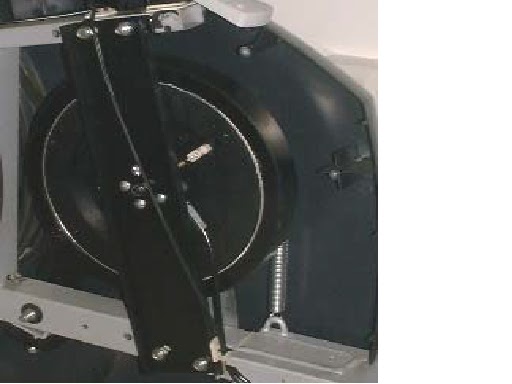
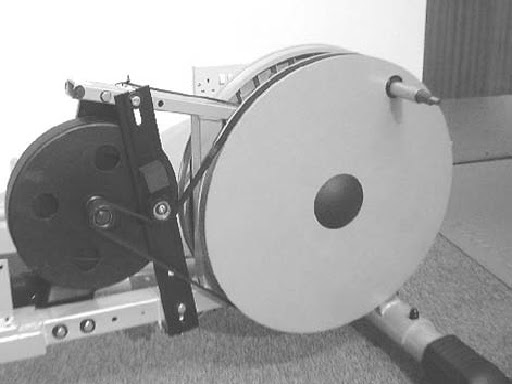
The transmission system consists of a rear drum which drives the resistance flywheel via a grooved belt which is adjusted and controlled with a tensioning wheel device. This system has varied between models and the 2 main different systems are shown.


TRANSMISSION BELT
The transmission belt if not correctly aligned tensioned can cause noise and long-term damage to the belt and other associated components. It will be necessary to remove both covers and disconnect both foot –tubes to work on transmission problems.  If the drive belt has removed itself or is worn/damaged after replacing the belt it will be necessary to check the tension and alignment to establish the cause of the failure.

REPLACING DRIVE BELT [FOR TYPE-1]
  • Slacken off the vertical tensioning bar by loosening the upper and lower locking bolts (f) and then remove lower adjusting bolt (g)
  • Remove the belt rotating by the drum clockwise whist feeding the belt off the flywheel boss. (See diagram 16 below) (Warning! Be careful not to trap fingers at this point.)
  • Before replacing the belt ensure that the grooves of the rear drum and resistance flywheel boss are cleared off any dirt or debris.
  • Recommend that at this point the lower adjuster bolt is unscrewed, the spring that is sometimes located at the bottom of the vertical tensioning bar is removed, and the adjusting bolt re-fitted but not tightened. The spring can be discarded as it is not absolutely required.
  • Set the rear drum so that the axle stub is in a vertical position. Introduce the belt by fitting it over the resistance flywheel boss (groove side down) and under the upper tension wheel.
  • Run the belt on to the rear drum by feeding it round the top of the drum whilst rotating the drum in a clockwise direction. Continue to rotate the drum whilst forcing the belt to remain in place with your hand. Please ensure that at this point the belt remains on the resistance flywheel boss by observing its position during rotation. (Warning! Be careful not to trap fingers at this point.)


  • Adjust the drive belt tension. Screw the lower adjusting bolt until a satisfactory tension is achieved. The recommended tension should be set so that with firm pressure the drive belt can only be deflected in one direction by approximately 3 mm at the point shown. Inadequate tension can cause the belt to slip producing a squealing noise and unsmooth action Too greater tension will place undue pressure on the rear drum and bearings. When set re-tighten upper and lower locking bolts.

CHECKING THE SETTING BELT ALIGNMENT
  • Rotate drum in an anti – clockwise direction (simulating forward motion in use). Observe the belt alignment. Rotate the drum in the opposite direction (simulating reverse motion in use).  Observe the belt alignment. If the belt runs out of line it may be caused by incorrect tolerance of frame components.
  • Dressing the belt. We recommend that at this point that both sides of the belt are ‘dressed’ with light coating of French chalk as this can reduce noise and increase longevity of the belt
TYPE -2
  • Slacken off the vertical tensioning bar by loosening the upper and lower locking bolts (h) and then remove lower adjusting bolt. Unhook the spring attached to the floating tension wheel and let the wheel and arm fall away.
  • Remove the belt rotating by the drum clockwise whist feeding the belt off the flywheel boss. Se diagram 16 above) (Warning! Be careful not to trap fingers at this point.)
  • Before replacing the belt ensure that the grooves of the rear drum and resistance flywheel boss are cleared of any dirt or debris.
  • Recommend that at this point the lower adjuster bolt (i) is unscrewed, the spring that is sometimes located at the bottom of the vertical tensioning bar is removed, and the adjusting bolt re-fitted but not tightened. The spring can be discarded as it is not absolutely required. If you wish to remove the vertical tensioning bar then unscrew and remove the upper and lower locking bolts completely and the bar can be removed.
  • Set the rear drum so that the axle stub is in a vertical position. Introduce the belt by fitting it over the resistance flywheel boss (groove side down) and under the upper tension wheel (k), under over the top of the floating tension wheel.
  • Run the belt on to the rear drum by feeding it round the top of the drum whilst rotating the drum in a clockwise direction. Continue to rotate the drum whilst forcing the belt to remain in place with your hand. Ensure that at this point the the belt remains on the resistance flywheel boss by observing its position during rotation. (Warning! Be careful not to trap fingers at this point.)
ADJUST THE DRIVE BELT TENSION
  • Screw the lower adjusting bolt until a satisfactory tension is achieved. The recommended tension should be set so that with firm pressure the drive belt can only be deflected in one direction by approximately 3 mm at the point shown. Inadequate tension can cause the belt to slip producing a squealing noise and unsmooth action Too greater tension will place undue pressure on the rear drum and bearings. When set re-tighten upper and lower locking bolts.
CHECKING AND SETTING BELT ALIGNMENT

  • Rotate drum in an anti – clockwise direction (simulating forward motion in use). Observe the belt alignment.  Rotate the drum in the opposite direction (simulating reverse motion in use).  Observe the belt alignment. If the belt runs out of line it may be caused by incorrect tolerance of frame components. Now reattach the floating tension arm spring so that the wheel is now applying pressure to the drive belt. Rotate the drum as indicated previously. If the belt moves out of alignment the floating arm assembly may need to be adjusted by bending the floating wheel arm in or out. If the belt is running out (towards the covers) bend the arm towards the frame. If the belt is running in (towards the frame) bend the arm towards the covers. Only a small amount of movement may be necessary to realign the belt. This operation can be assisted if the floating wheel assembly is removed from the machine by unscrewing the securing nut.
DRESSING THE BELT
  • Recommend that at this point that both sides of the belt are ‘dressed’ with light coating of French chalk as this can reduce noise and increase longevity of the belt.

BREMSHEY-SPORT ORBIT ELLIPTICAL TRAINER REAR DRUM ASSEMBLY

BREMSHEY-SPORT_ORBIT ELLIPTICAL TRAINER _ Rear Drum Assembly_


REAR DRUM ASSEMBLY

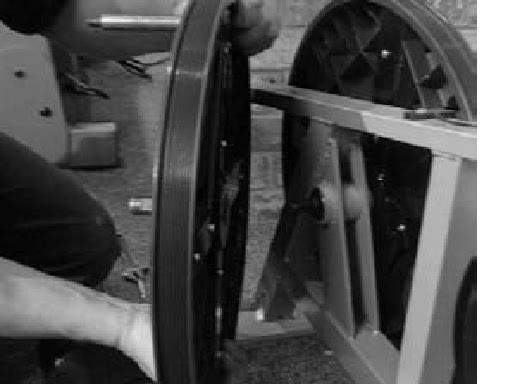
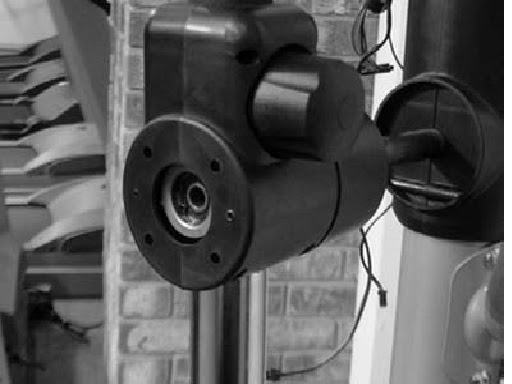
The rear drum assembly consists of 2 drum covers, 2 flywheel cross frame/axle units and one set of bearings. The following is a description of how the unit assembles/disassembles and failures associated with each component. Remove the foot-tubes, main covers and flywheel belt as previously outlined to access this area.

DRUM COVER AND CROSS FRAME ASSEMBLY
  • Check for problems within the rear drum assembly. Rotate the assembly checking for noise or unsmooth rotation which may indicate worn bearings. If there is a presence of lateral fluctuation during rotation this may cause belt misalignment and lead to noise problems. This can be an indication that the cross frames are distorted.
  • Check for play within the assembled units; Grab hold of the right drum and attempt to move in and out. If there is any lateral movement this could indicate that the securing bolt is loose. However, re-tightening this may only be a partial solution as wear may have already occurred on the cross frame axle joint. The cross frames often need to be replaced in this situation.  Finally remove cap from the center of the right-hand side drum cover.
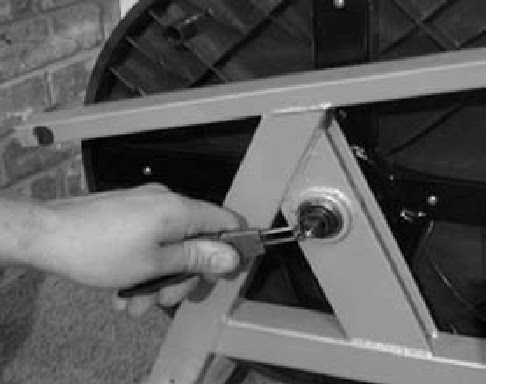
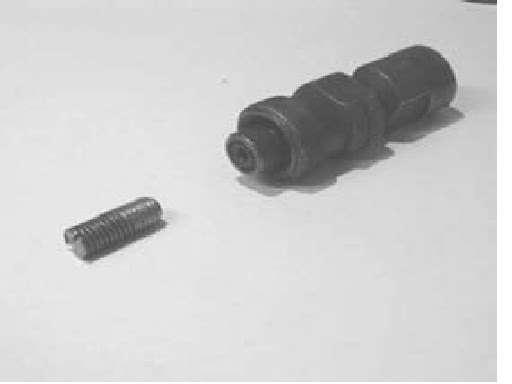
  • Separating drum cover and cross frame assemblies A standard (Shimano style) crank puller and adaptor will be required. Remove the securing bolt and replace it with the adaptor until approximately 5mm is still exposed above the internal face of the right side cross frame.
  • Screw the crank puller into the internal thread of the right side cross frame until firm.
  • Use a wrench to turn the top half of the extractor tool until the 2 units are separated. Remove extractor tool and adaptor.  
  • If required, remove the left side assembly by the following method: Remove the circlip and washer located on the end of the axle (projecting through the right side) and then pull the left side unit away. If the unit cannot be pulled off, tap the end of the axle gently with a soft faced hammer until removed.
The adaptor can be made by cutting a piece of 8 x 1.25 mm threaded steel rod to 25mm in length and cutting a slot into so that it can be turned using a slot–head screwdriver.


BREMSHEY-SPORT_ORBIT ELLIPTICAL TRAINER _ REPAIR HELP

BREMSHEY-SPORT_ORBIT ELLIPTICAL TRAINER _ REPAIR HELP


CHANGING REAR DRUM BRACE ASSEMBLY FRAME BEARING.

  • Place a long drift through the center hole of one bearing so that it rests against the inner side of the opposite bearing.
  • Tap the end of the drift with a hammer until the one bearing is removed.
  • Repeat the removal process with the other side. Be careful to remove the bush which separates the 2 bearings.
  • To re-fit new bearings push one bearing into the frame housing and tap lightly with a soft faced hammer until the face of the bearing is flush with the top of the frame. Great care should be taken not to damage the bearing.
  • Replace the separating bush and then re-fit second bearing as above.
REAR DRUM COVERS
  • The covers are identical except that the speed sensor is mounted within the left-hand unit, which is the drive belt side. If the drive side unit is worn or cracked the items can be exchanged providing that the speed sensor magnet is relocated.
NOISES PRODUCED BY READ DRUM COVERS
  • Each cover is secured to the cross frame units by 8 screws if one or several of the mounting posts are damaged this can produce a ‘creaking’ noise under pressure.  Also, this can lead to external cracks in the drum cover faces. A further service point can be to separate the drums from the cross frame and lubricate every contact point with grease.
RESISTANCE FLYWHEEL ASS'Y
The resistance flywheel rotates on a fixed axle using 2 sealed bearings held in place by an internal circlip on the drive belt side and a nylok nut on the other. If the bearings fail this will result in a ‘rumbling’ noise. It may be necessary to isolate the flywheel by detaching the drive belt. To replace the bearings:
  • Remove the foot-tubes, covers, drive belt & vertical tensioning bar using previously outlined procedures. In some models it may also be necessary to remove the rear drum & brace assembly or the as floating tension arm as outlined previously.
  • Slacken off the nylok nut on the non drive belt side of the flywheel axle by around 2 turns. To remove any friction, lightly tap the end of the axle with a soft faced hammer.
  • Remove the internal circlip from the centre of the flywheel assembly.
  • From the drive belt side, slide the flywheel off of the axle.


REPLACING FLYWHEEL BEARING
  • Place a long drift through the centre hole of one bearing so that it rests against the inner side of the opposite bearing.
  • Tap the end of the drift with a hammer until the one bearing is removed.
  • Repeat the removal process with the other side.
  • To re-fit new bearings push one bearing into the bearing housing and tap lightly with a soft faced hammer until the face of the bearing is flush with the top of the flywheel face. Great care should be taken not to damage the bearing.
  • Re-fit second bearing as above.


BEARINGS & JOINTS
The linkages between the swing arm, foot-tube and rear brace involve 3 main joints and bearings. These are often a source of noise or unsmooth operation and therefore attention is often required.

SWING ARM JOINT
The swing arms are mounted on to the handle bar axles and locked in place by a nylock nut supported by 2 washers. Inside each swing arm joint there is a combination of a sealed bearing and sinter bearing. It is very important that these areas are well lubricated with grease and this should be carried out as a part of a general service. The bearings are very seldom a problem and replacement is rarely required.


LOWER SWING ARM TO FOOT-TUBE JOINT
The 2 components are connected via an axle through the lower swing arm which has sinter bearing bushes inside. The axle is secured by 2 nylok nuts and supporting washers. It is very important that these areas are well lubricated with grease and this should be carried out as a part of a general service. The joint must be isolated to check its performance by either detaching the lower swing arm tube from the upper or detaching the foot-tube from the rear drum.  It is important that the combination of components is correctly assembled and adjusted.  The inner nut of the pair should be fully tightened first. Then the outer nut should be tightened so that the joint is correctly adjusted. There should be sufficient rotation of the joint allowed without ‘pinching’ or lateral movement.


FOOT-TUBE TO REAR DRUM BRACE JOINT
The foot-tube is connected to the rear drum brace via the axle stub. Inside the foot-tube joint is a sealed self-aligning bearing held in place by an internal circlip.  Either side of the bearing are 2 differently sized bushes. The components are secured in place by a nylok nut and washer. The self-aligning bearings rarely require attention but if required removing the circlip and carefully tapping out the bearing can make removal, replace with a reverse procedure. When re-assembled the nylok nut must be fully tightened. If there is any lateral play between the joint and the rear drum brace axle this may be due to play occurring within the area between each bush  and the self-aligning bearing. To correct this it may be necessary to replace either or both of the bushes or use shimming washers to reduce the space.